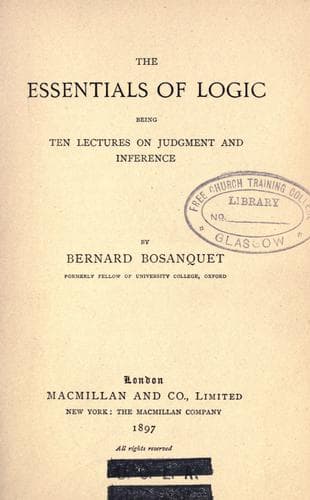
The Essentials of Logic, Being Ten Lectures on Judgment and InferenceBosanquet, Bernard
Philosophy
The Essentials of Logic, Being Ten Lectures on Judgment and Inference
Bosanquet, Bernard
Logic
{25} It is easy for an observer to detect intellectual necessity in
judgment, even where the judging subject is wholly unreflective. If
you contradict an obvious judgment made by an uneducated man, he will
no doubt be quite unable to point out the intellectual necessity
which constrains him to it, _i.e._ to argue in support of it; but he
will be bewildered and probably indignant, which shows that, unknown
to himself, his whole intellectual existence is really impeached by
impeachment of a necessary conclusion from it. Many people cannot see
the difference between impeaching their argument and impeaching their
veracity; and this confusion arises, I presume, from a just feeling
that their whole mind is on its trial in the one case as in the other,
although they do not distinguish between the forms of its action which
are concerned. We are told, indeed, in formal logic, that ordinary
statements of fact do not claim necessity; but this merely arises
from confining necessity to explicit necessity expressed in a special
grammatical form.
But, it may be objected, we do not always feel that every trivial
judgment emanates from and so implicates our whole mental constitution
and equipment. If I say to a friend, “I saw you at Charing Cross
yesterday,” and he says, “No, you could not, for I was out of town,”
then, unless I was very certain indeed, I should admit having made a
mistake, and think no more about the matter. That only means, (1) that
the unity of the mind is not thoroughly complete--there are many more
or less detached systems in the mind, and one of them may not be very
deeply inwrought in the whole intellectual frame; and (2) the necessity
of thought may itself modify the certainty of the fact, _e.g._ I know
that {26} a mistake of identity is quite a common thing, and this
knowledge co-operates with my friend’s denial.
But in any perceptive judgment, however unimportant its immediate
content, if it is clear and persistent, a contradiction is a most
serious thing. There is a well-known form of bewilderment connected
with the judgment of direction; if you forget or do not know of a turn
that you have taken, and come out, for example, on familiar ground from
the North when you think you are coming on it from the South, so that
objects have the reverse position of what you expected, then, supposing
that you cannot explain the contradiction, the result is sometimes
a very grave perplexity; some men are quite unhinged by it for the
moment, and a psychologist in France [1] has given it a new name,
“Vertigo of Direction.” This again shows how your whole intellectual
nature is staked upon the most trifling perception, and if you seem to
be forced to a flat contradiction even in the simplest judgment you are
almost “beside yourself.”
[1] M. Binet. See _Mind_, x. 156.
_Judgment universal_
Public-domain text, read in full here on John Shaqi.
Reviews
Reviews
No reviews yet
Be the first to share your thoughts on this work.
Join the Discussion
Join the discussion
Sign in to leave a comment or review.
Sign InorCreate an account