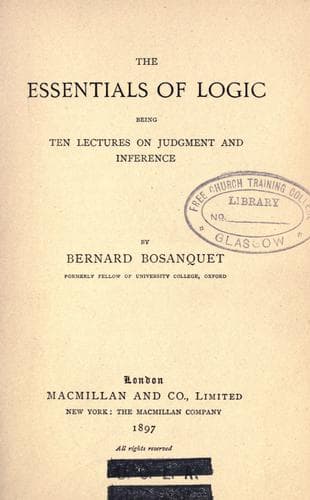
The Essentials of Logic, Being Ten Lectures on Judgment and InferenceBosanquet, Bernard
Philosophy
The Essentials of Logic, Being Ten Lectures on Judgment and Inference
Bosanquet, Bernard
Logic
(b) Judgment is universal. There are different senses of “universal” as
of “necessary.” We are now speaking only in the widest sense, in which
universality is a property of all judgment whatever. If we assume that
all our intellectual natures are the same, then to be universal is a
mere consequence of being necessary. I not only feel that my judgment
is inevitable for me, but I never think of doubting that, given the
same materials, it is obligatory for every other intelligent being.
If some one disagrees with a judgment of mine, I try to put the case
before him as it is in my mind. And I am absolutely sure that if I
could do so, he {27} would be obliged to judge as I do. If it were not
so, we should never think of arguing. We should simply say, “Perhaps
his mind is differently constituted from mine,” as, in fact, with
reference to special sets of dominant ideas, and to special provinces
of experience, we often do say. But these we regard as hindrances,
imperfections, accidents. We do not doubt that the system of reason is
active in him as in us.
And thus, as reason is essentially a system, the universality of
judgment involves something more. We not only think that our judgment
is obligatory upon every one else, in as far as they have the same
materials, but we think that it must be _consistent with_ the
judgments of all other persons, just as much as with our own. If it
is inconsistent with any other judgment, we think that one of the two
must be wrong; that is, we will not admit the possibility that the real
world, as others construct it, is out of harmony with the real world as
we construct it.
Thus knowledge, being judgment, is necessary and universal, and in the
widest sense this is true of all judgments.
_Judgment is constructive_
(c) These are two properties of the Judgment, but they do not tell us
what it is. We shall of course examine its nature more fully in the
later lectures. At present we need only think of it as affirmation.
This may be simply described as “pronouncing the interpretation of our
perceptions to form one system with the data of our perceptions.” We
may at once admit the distinction between _data_ and interpretation to
be only relative. Its relativity is the consequence of the constructed
or so to speak artificial {28} character of our real world. We can get
at no data unqualified by judgment.
Public-domain text, read in full here on John Shaqi.
Reviews
Reviews
No reviews yet
Be the first to share your thoughts on this work.
Join the Discussion
Join the discussion
Sign in to leave a comment or review.
Sign InorCreate an account