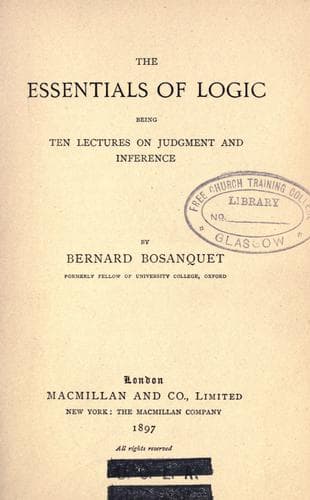
The Essentials of Logic, Being Ten Lectures on Judgment and InferenceBosanquet, Bernard
Philosophy
The Essentials of Logic, Being Ten Lectures on Judgment and Inference
Bosanquet, Bernard
Logic
In the example “That is a table,” the unity of judgment is so well
shown that the identification becomes almost unreal. In fact, we never
judge except to satisfy an interest and so simple a judgment used as an
example, apart from any context which could explain the need for it,
has an air of unreality. You may hear a child make such a judgment {31}
constantly in the sheer pleasure of recognition. An adult would never
make it explicitly unless in some particular context; but it is made,
as I shall maintain below, by the mere glance of his eye which takes in
the table as a real object in a real world of space. Its appearance to
the eye is in this case the datum, while the interpretation consists in
construing this appearance as a solid individual existence in space.
We will look at an example in which the discrimination of elements is
easier. Take the affirmation, “That is a cab,” assuming it to be made
from merely hearing a sound. In this we can much more nearly separate
the datum or minimum of sense from our enlargement or interpretation
of it, and we know that our interpretation is liable to be wrong;
that is to say, the reality into which we ought to construe the sound
may be some other kind of vehicle, and not a cab. Now compare this
with the affirmation, “That (which I see) is a cab.” This judgment of
sight-perception, though its terms are more inextricably interwoven,
has just the same elements in it as the judgment of sound-perception,
“That (which I hear) is a cab.” In the sound-perception the structure
is quite plain. A particular complex quality in the sound suggests as
its objective explanation, what is perfectly distinguishable from it in
thought, the movement of a cab on a particular kind of pavement. The
quality of the sound, its roughness, loudness, increase and decrease,
all form points of connection with the sound of a cab as we know it,
and with the speed, weight, etc. of such a vehicle. But it is quite
easy to consider the sound in itself apart from its interpretation, and
we sometimes feel the {32} interpretation to be more immediate, and
sometimes more inferential. We sometimes say, “I hear a cab,” just as
we say, “I see one,” but in case of sound we more often perhaps say,
“That sounds like--” such and such a thing, which indicates a doubt,
and the beginning of conscious inference.
Thus we see how continuous is the mental construction of reality.
From our unreflective education in seeing, hearing, and touching, to
the explicit judgment of the trained observer, which in its turn
passes readily into inference, there is no definite break. Once the
idea of reality, or of a world, is applied in practice (I do not say
reflectively grasped), there is no further difficulty in principle
throughout the whole process of its construction.
Public-domain text, read in full here on John Shaqi.
Reviews
Reviews
No reviews yet
Be the first to share your thoughts on this work.
Join the Discussion
Join the discussion
Sign in to leave a comment or review.
Sign InorCreate an account