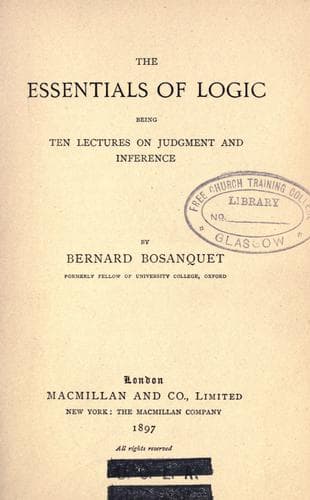
The Essentials of Logic, Being Ten Lectures on Judgment and InferenceBosanquet, Bernard
Philosophy
The Essentials of Logic, Being Ten Lectures on Judgment and Inference
Bosanquet, Bernard
Logic
Here is a table. In common language we should all say, “We see that
is a table.” The expression is quite correct, because human seeing
is a judgment. But yet, if you were asked to reduce your perception
to terms of sight pure and simple--I mean of visual sensation--why,
unless you were an analytic psychologist or a very skilful artist,
you would not be able to do it. To speak of one point only, you would
have to eliminate the attribute of depth and distance. That is all, so
far as mere vision is concerned, your theory and your interpretation.
The problem for an artist is to get back, at his high plane of
perceptive power, to what in theory would be the lower plane. He has to
re-translate his perception of a thing in space into a flat coloured
surface. The difference between his flat picture and a real object in
space is a rough measure of the difference made by interpretation or
implication in the datum of sense-perception when we say, judging by
sight only, “That is a table.” All the experiences of touch and motion,
from which we have learned to perceive the solidity of the object, are,
theoretically speaking, put into the judgment by us. They are not given
by the eye alone, although we cannot now {30} separate them from that
which is given by the eye alone. For the artist’s flat picture, which
I used as an illustration, is not a stage in our visual education.
Our visual education has proceeded _pari passu_ with our education by
touch and motion; and we saw objects in space as solids, long before
we reflected that for the eye alone a coloured surface would naturally
appear as flat. [1]
[1] The view that depth is a visual datum in the same sense as
breadth seems to me in flagrant contradiction with experience.
But for our present purpose the question is only one of degree,
as no one maintains, that either depth or breadth are seen
without education as an adult sees them.
But this impossibility of getting at an original datum only shows
how entirely we are right in saying that our world is constructed
by judgment. For the process of interpretative amplification passes
quite continuously from the unconscious to the conscious; and every
definitely expressed judgment, though perfectly homogeneous with the
processes which have qualified its datum, and though it may fall
wholly within the maximum of what in ordinary parlance we should call
a simple given perception, contains an identification of some ideal
element, enlargement, or interpretation, with that relatively given
element which reveals itself through a peculiar quality of presentness
pervading the “given” perception.
Public-domain text, read in full here on John Shaqi.
Reviews
Reviews
No reviews yet
Be the first to share your thoughts on this work.
Join the Discussion
Join the discussion
Sign in to leave a comment or review.
Sign InorCreate an account