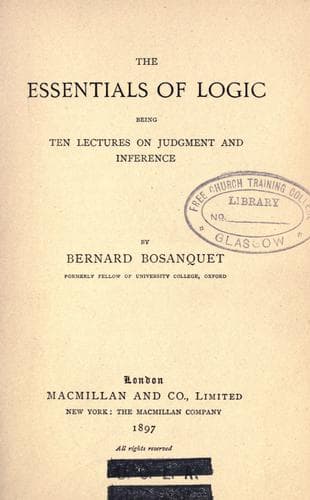
The Essentials of Logic, Being Ten Lectures on Judgment and InferenceBosanquet, Bernard
Philosophy
The Essentials of Logic, Being Ten Lectures on Judgment and Inference
Bosanquet, Bernard
Logic
And indeed the simplest example of what I am pointing out is the
arrangement of objects and places in space. The visual picture which
each of us forms of this room is certainly an affirmative judgment. It
is a judgment because it consists of ideas affirmed as true of reality.
As we look round, all the distances of the objects and the walls from
{35} each other, and their shapes and position, seem to be imprinted on
our minds without an effort. But really they are conclusions from long
education in the art of seeing and from the experience of the other
senses. They are an enlargement or interpretation of sense-perception,
taken as real, _i.e._ as forming a system which is one with the
content of sense-perception, and touches us through sense-perception,
and therefore they exist for us in the form of Judgment. And, as I
described before, our whole world, both of things in space and of our
own history and circumstances, is also affirmed as the background
implied in this picture. That is to say, it is all connected together,
it is all taken as equally real, and it is all vouched for by its
connection with what is given to us in perception. What do we mean by
saying that the Antipodes are real, and implied in my perception of
this room? We mean that they are an element, necessary to educated
thought, in the same system with which I am in contact at this moment
by sight, touch, and hearing, the system of reality. And though I may
not have explicitly thoughts of them since entering the room till now,
yet, if they were no part of my affirmed system of ideas, my perception
of anything in space would be quite different from what it is.
This sense of necessary connection is confined, I think, to our
_waking_ consciousness. Of course there are degrees between waking and
dreaming; but I should be inclined to set up the presence or absence
of judgment as a very fair test of those degrees. We say that a man
is _awake_ in as far as he is aware (i) of a reality which is not his
mere course of consciousness, and (ii.) of the same reality of which
other {36} people are aware; _i.e._ in as far as he identifies his
present perception with a reality, and that the real reality. It is
said that surprise, _i.e._ the sense of conflict between expectation
and the reality, is absent In dreams, and in a very remarkable passage
Aeschylus identifies the life of the savage in his (imaginary)
primitive state with a dream-life, considered as a life of sensuous
presentation, in which the interpretative judgment of perception was
absent. With extraordinary profoundness, in portraying this all but
animal existence, he strikes out all those relations to the objective
world by which man forms for himself a system that goes beyond the
present, so as to leave the stream of presentation without any
background of organised reality. [1]
[1] I quote from Mrs. Browning’s Translation of the _Prometheus
Bound_, which seems close enough for the present purpose.
Public-domain text, read in full here on John Shaqi.
Reviews
Reviews
No reviews yet
Be the first to share your thoughts on this work.
Join the Discussion
Join the discussion
Sign in to leave a comment or review.
Sign InorCreate an account