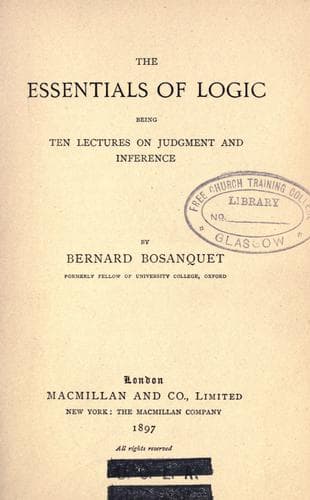
The Essentials of Logic, Being Ten Lectures on Judgment and InferenceBosanquet, Bernard
Philosophy
The Essentials of Logic, Being Ten Lectures on Judgment and Inference
Bosanquet, Bernard
Logic
“And let me tell you, not as taunting men,
But teaching you the intention of my gifts,
How first, _beholding, they beheld in vain.
And hearing, heard not, but, like shapes in dreams_,
Mixed all things wildly down the tedious time,
Nor knew to build a house against the sun
With wicketed sides, nor any woodwork knew,
But lived, like silly ants, beneath the ground,
In hollow caves unsunned. There came to them
No steadfast sign of winter, nor of spring
Flower-perfumed, nor of summer full of fruit.
But blindly and lawlessly they did all things,
Until I taught them how the stars do rise
And set in mystery, and devised for them
Number, the inducer of philosophies.
The synthesis of letters, and besides,
The artificer of all things, Memory,
That sweet muse-mother.” _Pr_., v. 445, ff.
The expression “seeing saw not, and hearing heard not” appears to
suggest the contrast of presentation and objective perception.
{37} It may be asked, “Why should not a man form for himself a system
which interprets his own perception, but is discrepant from the system
of every one else? Should we in that case count him as awake?” Yes, he
would be awake, but he would be mad. Suppose, being a common man, he
interprets all his perceptions into a system which makes him out to
be King of England; in such a case he cannot be set down as dreaming,
because he is alleging a connection which goes beyond his present
perception, and has, ostensibly, been propounded as an interpretation
of it into a systematic order of things. He has in short _a_ world, but
he has broken away from _the_ world, and therefore we pronounce him
mad. A completely new vision of life may cause a man to be thought mad.
[1]
[1] See Browning’s _Epistle of Karshish_.
The whole world, then, of our waking [1] consciousness may be treated
as a single connected predicate affirmed as an enlargement of present
perception. All that we take to be real is by the mere fact of being so
taken, brought within an affirmative judgment.
[1] I do not mean to say that judgment and consciousness of
a world can be wholly absent in dreams, and often no doubt
they are distinctly present. But in those dreams, in my own
experience the normal ones, which leave behind a mere impression
that unrecognisable images have passed before the mind, judgment
and the sense of reality must surely have all but disappeared. I
am inclined to think that dreams are very much rationalised in
recollection and description.
_Comparison with world as Will_
Public-domain text, read in full here on John Shaqi.
Reviews
Reviews
No reviews yet
Be the first to share your thoughts on this work.
Join the Discussion
Join the discussion
Sign in to leave a comment or review.
Sign InorCreate an account