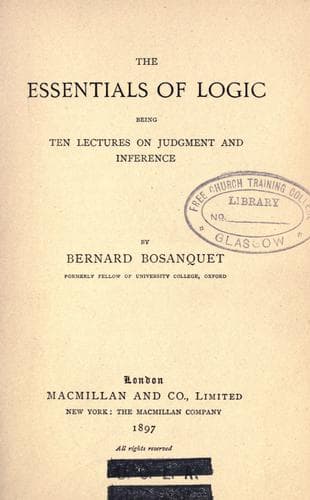
The Essentials of Logic, Being Ten Lectures on Judgment and Inference — John Shaqi
The Essentials of Logic, Being Ten Lectures on Judgment and InferenceBosanquet, Bernard
Philosophy
The Essentials of Logic, Being Ten Lectures on Judgment and Inference
Bosanquet, Bernard
Logic
But the world of knowledge has a unity which the world of organic
individuals cannot claim; and this whole system of functions is itself,
for our intelligence, approximately a single function or system,
corresponding in structure to each of its individual parts, as though
the plant world or animal world were itself in turn a plant or animal.
We cannot hope to exhaust the shapes taken by the pervading fundamental
function of intelligence. We shall only attempt to understand the
analogies and differences between some few of its leading types.
{61}
LECTURE IV TYPES OF JUDGMENT AND THE GENERAL CONDITIONS
INVOLVED IN ASSERTION
_Correspondence between types of Judgment and nature of objects as
Knowledge_
1. The question of correspondence between the types of Judgment and the
orders of Knowledge was really anticipated in discussing the relation
between the content and the form of knowledge. We saw that the content
or matter and nature known determines on the whole the form or method
of knowledge by which it can be known.
I give a few cases of this correspondence, not professing to complete
the list. We should accustom ourselves to think of these forms as
constituting a progression in the sense that each of them betrays a
reference to an ideal of knowledge which in itself it is unable to
fulfil, and therefore inevitably suggests some further or divergent
form. And the defect by which the forms contradict the ideal, is felt
by us as a defect in their grasp of reality, in their presentation of
real connections.
_“Impersonal” Judgment_
_a_. We think of the judgment as predicating an ideal content of a
subject indicated in present perception. But there are judgments
which scarcely have an immediate subject at all, such as “How hot!”
“Bad!” “It hurts!” In the judgments thus represented the true subject
is some {62} undefined aspect of the given complex presentation. Of
course the words which we use are not an absolutely safe guide to the
judgment--they may be merely an abbreviation. But there are typical
judgments of this kind in which we merely mean to connect some namable
content with that which can only be defined as the focus of attention
at the moment. Such judgments might be called predications of mere
quality. The only link by which they bind their parts into a whole is
a feeling referred to our momentary surroundings. A _mere_ quality, if
not defined or analysed, or a feeling of pleasure or pain, is the sort
of object which can be expressed in such a judgment.
_Perceptive Judgment_
Public-domain text, read in full here on John Shaqi.
Reviews
Reviews
No reviews yet
Be the first to share your thoughts on this work.
Join the Discussion
Join the discussion
Sign in to leave a comment or review.
Sign InorCreate an account