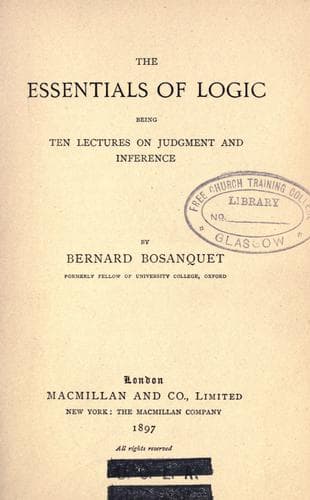
The Essentials of Logic, Being Ten Lectures on Judgment and Inference — John Shaqi
The Essentials of Logic, Being Ten Lectures on Judgment and InferenceBosanquet, Bernard
Philosophy
The Essentials of Logic, Being Ten Lectures on Judgment and Inference
Bosanquet, Bernard
Logic
Knowledge is always Judgment. Judgment is constructive, for us, of
the real world. Constructing the real world means interpreting or
amplifying our present perception by what we are obliged to think,
which we take as all belonging to a single system one with itself,
and with what constrains us in sense-perception, and objective in the
sense that its parts act on each other independently of our individual
apprehension, and that we are obliged to think them thus. The process
of construction is always that of exhibiting a whole in its parts,
_i.e._ an identity in its differences; that is to say, it is always
both analytic and synthetic. The objects of knowledge differ in the
mode of relation between their {59} parts and the whole, and thus give
rise to different types of judgment and inference; and this difference
in the form of knowledge is a difference in the content of Logic, which
deals with the objects of experience only from the point of view of
their properties as objects in an intellectual world.
_Conclusion_
5. I hope that these general lectures, which, as I am quite aware, have
anticipated the treatment of many difficult questions which they have
not attempted to solve, have been successful in putting the problem of
Logic before us with some degree of vividness. If this problem were
thoroughly impressed upon our minds, I should say that we had already
gained something definite from this course of study. The points which I
desire to emphasise are two.
(1) I hope that we have learned to realise the world of our knowledge
as a living growth, sustained by the energy of our intelligence; and to
understand that we do not start with a ready-made world in common, but
can only enter upon the inheritance of science and civilisation as the
result of courage, labour, and reasonable perseverance; and further,
that we retain this inheritance just as long as our endurance and
capacity hold out, and no longer.
And (2) I have attempted to make clear that this living growth, our
knowledge, is like the vegetable or animal world in being composed
of infinite minor systems, each and all of which are at bottom the
same function with corresponding parts or elements, modified by
adaption to the environment. So that the task of analysing the form of
judgment bears a certain resemblance to that of analysing the forms
of plants. Just as from the single cell of the undifferentiated Alga,
to {60} the most highly organised flower or tree, we have the same
formation, with its characteristic functions and operations, so from
the undifferentiated judgment, which in linguistic form resembles
an ejaculation or interjection, to the reasonable systems of exact
or philosophical science, we find the same systematic function with
corresponding elements.
Public-domain text, read in full here on John Shaqi.
Reviews
Reviews
No reviews yet
Be the first to share your thoughts on this work.
Join the Discussion
Join the discussion
Sign in to leave a comment or review.
Sign InorCreate an account