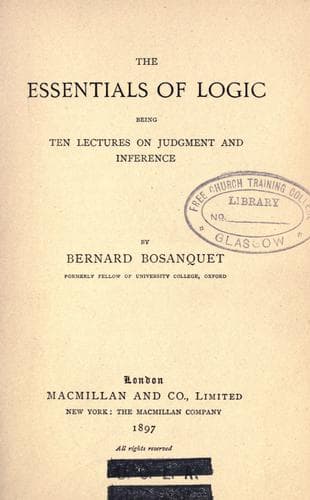
The Essentials of Logic, Being Ten Lectures on Judgment and InferenceBosanquet, Bernard
Philosophy
The Essentials of Logic, Being Ten Lectures on Judgment and Inference
Bosanquet, Bernard
Logic
We have no other term than perception to express the process which is
employed in scientific observation and experiment. But it is plain that
so soon as the judgment that refers to “This” is modified through the
inevitable demand for qualification by exact ideas--“_This_ hurts me,”
“_What_ hurts you?” “This old sprain, at the pace we are walking”--a
conflict of elements has arisen within the judgment. And as commonplace
perception passes into scientific observation, the qualifying ideas, on
which truth and relevancy depend, dwarf the importance of the “this,”
and ultimately oust it altogether. That is a simple case in which
the ideal of knowledge and the nature of reality operate within the
judgment to split asunder its primitive form. The subject as expressed
by a pure demonstrative refuses to {64} take account either of truth,
_i.e._ consistency with knowledge as a whole, or of relevancy, _i.e._
consistency with the relation involved in the particular predication
that may be in question. Our commonplace perception halts between
these two extremes. It deals with the world of individual objects and
persons, which, being already systematised according to our current
observations and interests, has, so long as we keep to its order, a
sufficient degree of truth and relevancy for the needs of daily life.
Thus if I say, “This book will do as a desk to write upon,” the truth
of the qualification “book” (_i.e._ the reality of the subject) is
assumed on the ground of the facility of recognising a well-known
“thing,” while the relevancy of the qualification “book” is not
questioned, because we accept an individual thing as an object of
habitual interest _qua_ individual, and do not demand that whenever it
is named those properties alone should be indicated which are relevant
to the purpose for which it is named. The “thing” is a current coin of
popular thought, and makes common perception workable without straining
after a special relevancy in the subject of every predication. Such
special relevancy leads ultimately to the ideal of _definition_, in
which subject and predicate are adequate to each other and necessarily
connected. A definitory judgment drops the demonstrative and relies
on qualifying ideas alone. It is therefore an abstract universal
Judgment, while the Judgment of Perception, so long as it retains the
demonstrative, is a Singular Judgment.
_Proper names in Judgment_
_c_. But a very curious example of a divergence or half-way house in
Knowledge is that form of the singular Judgment in which the subject is
a proper name. A proper name is {65} designative and not definitory.
It may be described as a generalised demonstrative pronoun--a
demonstrative pronoun which has the same particular reference in the
mouth of every one who uses, it, and beyond the given present of time.
Public-domain text, read in full here on John Shaqi.
Reviews
Reviews
No reviews yet
Be the first to share your thoughts on this work.
Join the Discussion
Join the discussion
Sign in to leave a comment or review.
Sign InorCreate an account