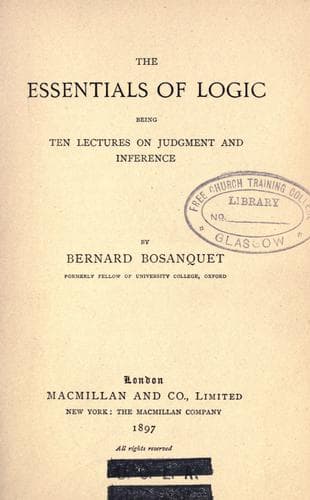
The Essentials of Logic, Being Ten Lectures on Judgment and InferenceBosanquet, Bernard
Philosophy
The Essentials of Logic, Being Ten Lectures on Judgment and Inference
Bosanquet, Bernard
Logic
So the reference of a proper name is a good example of what we called
a universal or an identity. That which is referred to by such a name
is a person or thing whose existence is extended in time and its parts
bound together by some continuous quality--an _individual_ person or
thing and the whole of this individuality is referred to in whatever
is affirmed about it. Thus the reference of such a name is universal,
not as including more than one individual, but as including in the
identity of the individual numberless differences--the acts, events,
and relations that make up its history and situation.
What kinds of things are called by Proper Names, and why? This question
is akin to the doctrine of Connotation and Denotation, which will be
discussed in the next lecture. It is a very good problem to think over
beforehand, noting especially the limiting cases, in which either some
_people_ give proper names to things to which other people do not give
them, or some _things_ are given proper names while other things of the
same general kind are not. These judgments, which are both Singular and
Universal, may perhaps be called for distinction’s sake “Individual”
Judgments.
_Abstract Judgment_
_d_. The demonstrative perception may also be replaced by a more or
less complete analysis or definition.
Within this province Definition of a concrete whole is one extreme,
_e.g_. “Human Society is a system of wills”; {66} that of an abstract
whole the other extreme, “12 = 7 + 5.” There are all degrees, between
these two, in the amount of modification which the parts undergo
by belonging to the whole. There are also all sorts of incomplete
definitions, expressing merely the effects of single conditions out of
those which go to make up a whole. These form the abstract universal
judgments of the exact sciences, such as, “If water is heated to 212°
Fahr. under one atmosphere it boils.” In all these cases some idea,
“abstract” as being cut loose from the focus of present perception,
whether abstract or concrete in its content, replaces the demonstrative
of the judgment which is a perception. These are the judgments which in
the ordinary logical classification rank as universal.
_The general definition of Judgment_
2. It was quite right of us to consider some types of judgment
before trying to define it generally. It is hopeless to understand a
definition unless the object to be defined is tolerably familiar. We
have said a great deal about knowledge and about judgment as the organ
or medium of knowledge. Now we want to study particular judgments in
their parts and working, and observe how they perform their function of
constructing reality.
Now, for our purpose, we may take the clearest cases of judgment, viz.
the meanings of propositions.
The distinctive character of Judgment as contrasted with every other
act of mind is that it claims to be true, _i.e._ pre-supposes the
distinction between truth and falsity.
Public-domain text, read in full here on John Shaqi.
Reviews
Reviews
No reviews yet
Be the first to share your thoughts on this work.
Join the Discussion
Join the discussion
Sign in to leave a comment or review.
Sign InorCreate an account