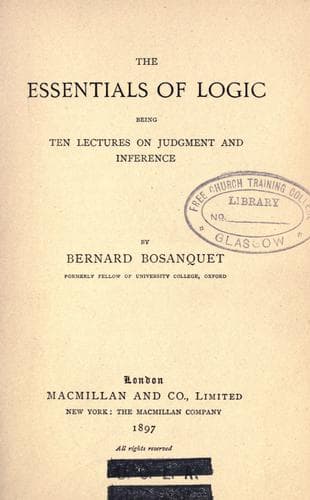
The Essentials of Logic, Being Ten Lectures on Judgment and InferenceBosanquet, Bernard
Philosophy
The Essentials of Logic, Being Ten Lectures on Judgment and Inference
Bosanquet, Bernard
Logic
If we insist on considering it in its isolation, we probably eke it
out in thought by an unarticulated affirmation such as that which
constitutes an impersonal judgment; in other words, we affirm it to
belong to reality under some condition which remains unspecified.
Thus the linguistic form of the relative clause, as also the separate
existence of the spoken or written word, produces an illusion which
has governed the greater part of logical theory so far as concerns the
separation between concept and judgment, _i.e._ between entertaining
ideas and affirming them in reality. In our waking life, all thought is
judgment, every idea is referred to reality, and in being so referred,
is ultimately affirmed of reality. The separation of elements in the
texture of Judgment into Subjects and Predicates which, as separated,
are conceived as _possible_ Subjects and Predicates, is therefore
{74} theoretical and ideal, an analysis of a living tissue, not an
enumeration of loose bricks out of which something is about to be built
up.
_The kind of ideas which can claim truth_
(iii.) “Idea” has two principal meanings.
(_a_) A psychical presentation and
(_b_) An identical reference.
This distinction is the same as that between our course of ideas and
our world of knowledge. We must try now to define it more accurately.
(_a_) An idea as a psychical presentation is strictly a particular.
Every moment of consciousness is full of a given complex of
presentation which passes away and can never be repeated without some
difference. For this purpose a representation is just the same as a
presentation; is, in fact, a presentation. Its detail at any given
moment is filled in by the influence of the moment, and it can never
occur again with precisely the same elements of detail as before.
If we use the term “idea” in this sense, as a momentary particular
mental state, it is nonsense to speak of having the same idea twice,
or of referring it to a reality other than our mental life. The idea
in this sense is a psychical image. We cannot illustrate this usage
by any recognisable part of our mental furniture, for every such part
which can be described and indicated by a general name, is something
more than a psychical image. We can only say that that which at any
moment we have in consciousness, when our waking perception encounters
reality, is such an idea, and so too is the image supplied by memory,
when considered simply as a datum, a fact, in our mental history.
Public-domain text, read in full here on John Shaqi.
Reviews
Reviews
No reviews yet
Be the first to share your thoughts on this work.
Join the Discussion
Join the discussion
Sign in to leave a comment or review.
Sign InorCreate an account