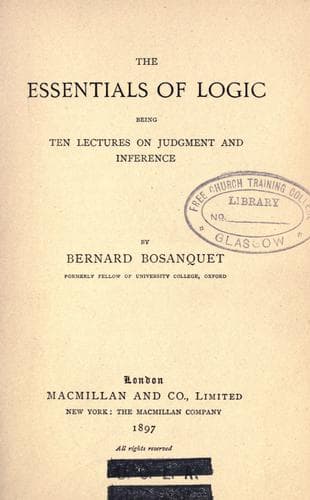
The Essentials of Logic, Being Ten Lectures on Judgment and InferenceBosanquet, Bernard
Philosophy
The Essentials of Logic, Being Ten Lectures on Judgment and Inference
Bosanquet, Bernard
Logic
Any assertion which is incredible because the identical quality is
wanting will illustrate the required structure. There is a story
commented on by Thackeray in one of his occasional papers, which
implied that the Duke of Wellington took home note-paper from a club to
which he did not {72} belong. (Thackeray gives the true explanation of
the fact on which the suggestion was founded.) The identity concerned
in this case would be that of character. Can we find an identity
between the character involved in a piece of meanness like that
suggested and the character of the Duke of Wellington? No; and _prima
facie_ therefore the judgment is false. The identity which should bind
it together breaks it in two. But yet, again: supposing the external
evidence to be strong enough, we may have to accept a fact which
conflicts with a man’s character as we conceive it. That is so: in such
a case one kind of identity appears to contradict the other. I may
think that I saw a man with my own eyes, doing something which wholly
contradicts his character as I judge it. Then there is a conflict
between identity in personal appearance and identity in character,
and we have to criticise the two estimates of identity--_i.e._ to
refer them both to our general system of knowledge, and to accept the
connection which can be best adapted to that system.
We have got, then, as the active elements in Judgment a Subject in
Reality, the meaning of an idea, and an identity between them.
Is this enough? Have we the peculiar act of affirmation wherever we
have these conditions?
This is not the question by what elements of language the judgment is
rendered. We shall speak of that in the next lecture. The question is
now, simply, “Is a significant idea, referred to reality, always an
assertion?”
The first answer seems to be that such an idea is always _in_ an
assertion, but need not constitute the whole of an {73} assertion. If
we think of a subject in judgment which is represented by a relative
sentence, it seems clear that any idea which can stand a predicate can
also form a part of a subject. “The exhibition which it is proposed
to hold at Chicago in 1893”--has in effect just the same elements of
meaning, and just the same reference to a point in our world of reality
as if the sentence ran, “It is proposed to hold an exhibition at
Chicago in 1893.” In common parlance we should say, that in the former
case we entertain an idea--or conceive or represent it--while in the
latter case we affirm it.
But if we go on to say that the former kind of sentence as truly
represents the nature of thought as the latter, then it seems that we
are mistaken. Even language does not admit such a clause to the rank of
an independent sentence.
Public-domain text, read in full here on John Shaqi.
Reviews
Reviews
No reviews yet
Be the first to share your thoughts on this work.
Join the Discussion
Join the discussion
Sign in to leave a comment or review.
Sign InorCreate an account