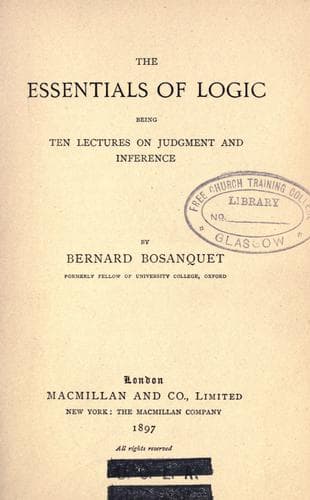
The Essentials of Logic, Being Ten Lectures on Judgment and Inference — John Shaqi
The Essentials of Logic, Being Ten Lectures on Judgment and InferenceBosanquet, Bernard
Philosophy
The Essentials of Logic, Being Ten Lectures on Judgment and Inference
Bosanquet, Bernard
Logic
5. Let us illustrate this building up by thinking of the world, our
surroundings, as an animal must be aware of it. The lowest beginnings
of sight, for example, give no colour and no shape. An animal in this
stage can, probably, only just take warning if a dark object comes
between him and the light. Therefore he cannot have the ordered visual
image of space definitely stretching away all round him, which is the
primary basis of our idea of a world. He can move, no doubt, but there
is nothing to make us suppose that he records and co-ordinates the
results of his movements into anything like that permanent order of
objects which must be constructed in some way by a human being even
though born blind. Succession, we might say, is much more powerful
with animals than co-existence; but we should have to guard ourselves
against supposing that this was what we mean by succession, that is,
a process definitely recognised as in time, with a connection of some
reasonable kind between its phases. For the most part with animals
out of sight is out of mind; if so, the present is not interpreted,
enlarged, and arranged with reference to what is not present in time
or space by them as it is by us. And therefore the consciousness of a
single system of things, {7} permanent, and distinct from the momentary
presentations of the senses, cannot, in all probability, grow up for
them. If so, they have no real world, but only a dream world, [1]
_i.e._ a world not contrasted with the stream of presentation, nor
taken as the common theatre of all actions and events. This difference
between the world of an animal and that of a human being, is a rough
measure of what man does by mental or intellectual construction in
making his world.
[1] The character of the sensory powers, which are strongest in
many animals, contributes to this conclusion. Mr. F.H. Bradley
is sure that his dog’s system of logic, if he had one, would
run, “What exists smells; what does not smell is nothing.” The
sense of smell can scarcely give rise to the idea of a world of
objects. It has hardly any capacity of structural discernment.
_The world as objective_
6. We have now got the idea of a “world,” as a system of things and
persons connected together, taken to be the same for oneself at
different times and for different minds at the same time, yet existing,
for oneself, in the medium of one’s individual consciousness.
Public-domain text, read in full here on John Shaqi.
Reviews
Reviews
No reviews yet
Be the first to share your thoughts on this work.
Join the Discussion
Join the discussion
Sign in to leave a comment or review.
Sign InorCreate an account