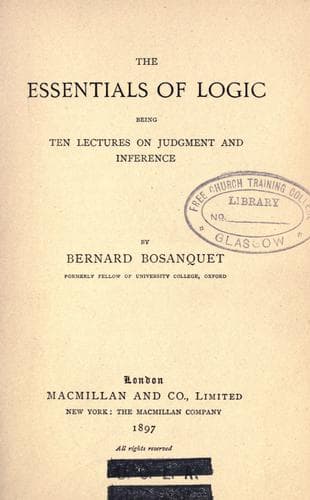
The Essentials of Logic, Being Ten Lectures on Judgment and InferenceBosanquet, Bernard
Philosophy
The Essentials of Logic, Being Ten Lectures on Judgment and Inference
Bosanquet, Bernard
Logic
We see at once that we cannot stop here. We have really got a
contradiction. If the parts of our world are connected with each other,
they are not merely dependent upon us, that is, upon the changes of our
consciousness. And we all take them to be independent of us, in the
sense that we do not suppose the presence or absence of our perception
to make any difference to the world except by the continuance or
cessation of our perception of it or of its parts. This is the state
of mind in which we practically live, philosophers and all. I do not
really take notice of any difference in mode of existence between the
wall in front of me, which I see, and the wall behind me, which I {8}
do not see. While you are in this lecture-hall, if you think of your
rooms at home, you think of them as they look, that is, as they would
look if you were there to see them. How else, indeed, could you think
of them? This is practically necessary, and therefore, for practical
purposes, true.
But if you take it as a theory, omitting the hypothetical factor,
“if I was there to see,” you go wrong. You then treat your world
as being, outside your consciousness, the same that it is inside
your consciousness, without allowing for the withdrawal of your
consciousness. You are then on the way to think that the world, _as
you see, hear, and feel it_, is outside your mind, and that the sight,
hearing, feeling, and the ideas born of them, are inside your mind as
a sort of faint and imperfect _copy_ of the world which you then call
“external,” _in the sense of outside the mind_.
_Common sense_
i. The first position was that of common sense. The second is that
of common-sense theory. Common sense is quite justified. It says,
“Things affect each other, but the mere presence and absence of our
perception does not affect them.” For practical purposes we must
treat them as being, when unapprehended by our minds, just the same
as when apprehended by our minds. This is the first idea or rather
postulate--for it is not a theoretical idea--of objectivity. Objective
= “independent of our consciousness for practical purposes.”
_Common-sense theory_
Public-domain text, read in full here on John Shaqi.
Reviews
Reviews
No reviews yet
Be the first to share your thoughts on this work.
Join the Discussion
Join the discussion
Sign in to leave a comment or review.
Sign InorCreate an account