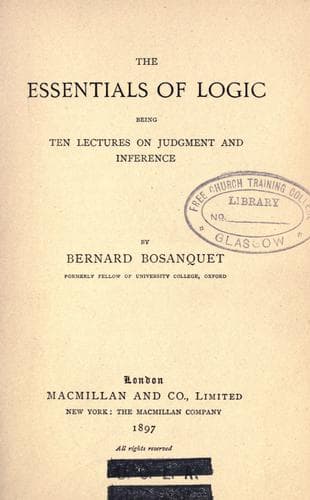
The Essentials of Logic, Being Ten Lectures on Judgment and InferenceBosanquet, Bernard
Philosophy
The Essentials of Logic, Being Ten Lectures on Judgment and Inference
Bosanquet, Bernard
Logic
It is far more simple and true to say that Judgment is always the
analysis _and_ synthesis of elements in some one thing or ideal
content. “Gold is yellow” has not within it, as Jevons says it has, [1]
any direct comparison of gold with other yellow substances. It simply
drags to light the property “yellow” as distinct within the complex of
attributes belonging to gold, while at the same time insisting that
this property--this meaning of an idea--belongs to, is of one piece
with, perceived reality in so far as gold is given in such reality.
The Judgment exhibits the content in its parts. It breaks it up, and
pronounces it to be all of one tissue, by one and the same indivisible
act. We should practically have a much fairer chance of seeing clearly
what Judgment is if we began by considering it as not two things or
two terms — but as one thing or one term drawn out into elements by
discriminating selection. Even if the paradox that every “Thing” is
a Judgment neglects some necessary distinctions, I am convinced that
we shall understand Judgment much more clearly if we do our best to
approach it from this point of view. Whenever we look or listen, and
_notice_ features and qualities in the perceptions that arrest the
eye and ear, we are rapidly and continuously judging. “The fire is
crackling,” “The daylight is waning,” “That bookshelf is not full,”
“The window-curtain is twisted.” In none of these cases is there
any separation other than an intellectual distinction between the
predicated content and the perceived reality. The Judgment is simply
a distinct {107} insistence on a quality within a certain focus of
reality as belonging to that reality. This is the fundamental nature of
Judgment.
[1] _Loc. cit_.
Therefore, to draw our conclusion as to the Unity of the Judgment, it
is not a transition from one mental state to another; the relation of
which it consists is not between ideas in it, but is the content of the
idea which forms it. Judgment is not primarily comparison between two
things; it is a thing or content displayed as possessing some definite
relation or quality within its identity. Every Judgment is the content
of one idea, but you may of course distinguish relations between ideal
elements within this idea. “Fire causes heat” is a single content or
idea, the nature of fire, expanded into one of its properties.
_Distinction between Subject and Predicate_
5. But then, if the whole Judgment is a single content, what is the
difference between Subject and Predicate, and is it necessary to
distinguish Subject from Predicate at all? If _some_ Judgments can be
made without explicit Subjects, cannot _all_ be made in that way?
Public-domain text, read in full here on John Shaqi.
Reviews
Reviews
No reviews yet
Be the first to share your thoughts on this work.
Elsewhere in the archive
Join the Discussion
Join the discussion
Sign in to leave a comment or review.
Sign InorCreate an account