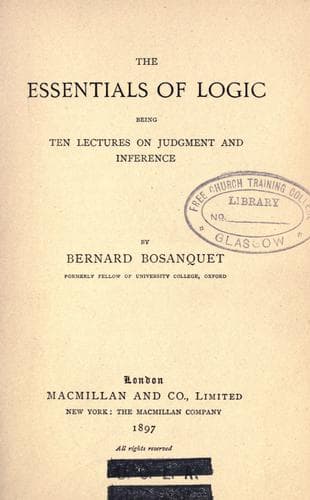
The Essentials of Logic, Being Ten Lectures on Judgment and InferenceBosanquet, Bernard
Philosophy
The Essentials of Logic, Being Ten Lectures on Judgment and Inference
Bosanquet, Bernard
Logic
This suggestion is very useful as carrying on the simplest type of
Judgment throughout the whole theory of Judgment. By a little torture
of expression any Judgment can be thrown into a form in which undefined
Reality is the general subject, and the whole mass of the Judgment
is the Predicate. “William Pitt was a great statesman” = “There was
a great statesman named William Pitt”; “The three angles of every
triangle are equal to two right angles” = “There are figures known as
triangles with their three angles equal to two right angles”; “All
citizens are members of a moral order” = “There is a moral order,
including the {108} relations of citizenship”; “All trespassers will
be prosecuted” = “Here are conditions which ensure the prosecution of
possible trespassers.” Or you might always put a subject, “Reality is
such that”--“Reality is characterised by.”
Thus we see that, as we have said before, in every Judgment the
ultimate subject is Reality, the world in contact with us as we have
already qualified it by previous Judgment. It is a less mistake to
reject the Subject and Predicate in the Judgment altogether, than to
think that they are separate things or ideas, and that in judging you
pass or change from one to the other. Always bear in mind that it is
possible to mass the whole Judgment as a single Predicate directly or
indirectly true of Reality.
Having said this much, to make the Unity of the Judgment unmistakable,
we may now safely distinguish between the Subject and Predicate
in the Judgment. And we shall find the safest clue to be that the
explicit Subject, when there is one, marks the place at which, or the
conditions under which, Reality accepts the Predicate. The natural
Subject is concrete, and the Predicate abstract; the Subject real, and
the Predicate ideal, but pronounced to be real. The reason of this is
that every Judgment is the connection of parts in a whole, and to be
a whole is the characteristic of reality. In other words, the natural
course of thought is to define further what is already in great part
defined, and our real world is that which we have so far defined. The
isolated judgments of the text-books make it very hard to grasp this,
because you seem to begin anywhere for no connected reason at all. But
if we reflect on actual thought, {109} we find that, as Mr. Stout very
cleverly says, we are always developing a “subject” which is in our
minds (in the ordinary sense of a “subject of conversation”), and this
subject is some region or province of the world of reality.
Public-domain text, read in full here on John Shaqi.
Reviews
Reviews
No reviews yet
Be the first to share your thoughts on this work.
Elsewhere in the archive
Join the Discussion
Join the discussion
Sign in to leave a comment or review.
Sign InorCreate an account