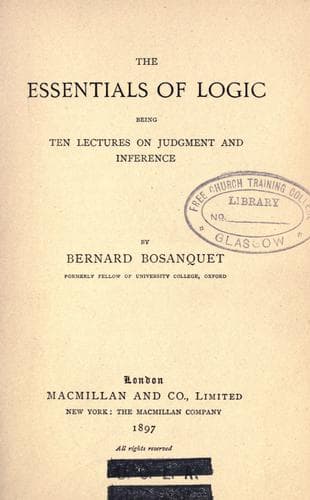
The Essentials of Logic, Being Ten Lectures on Judgment and InferenceBosanquet, Bernard
Philosophy
The Essentials of Logic, Being Ten Lectures on Judgment and Inference
Bosanquet, Bernard
Logic
Now the explicit Subject in Judgment or the grammatical Subject in
Proposition does not always set out the full nature of this, but
merely some mark or point in it which we wish to insist upon. So
that we may find in Judgment almost anything serving as explicit
Subject. Thus, as Aristotle said quite plainly and sensibly, it is
natural to say “The horse is white,” but we _may_ have occasion to say
“This white is a horse”; it depends on the way in which the Subject
comes into our minds. [1] Usually the Subject will be what Dr. Venn
calls the heavier term, _i.e._ the term with more connotation. When
there is no difference of concreteness between parts and whole, the
Judgment becomes reversible as in the equation 7 + 5 = 12. There is no
distinction here between Subject and Predicate. The real underlying
unity or Subject is the numerical system.
[1] See Prof. Bain, p. 56, upon the Universe, and Universe of
Discourse, _i.e._ the general subject which you have in your
mind.
Therefore by recognising Subject and Predicate we represent the
organisation of knowledge, and the connection of inherence or
consequence within the content of our knowledge. If we do not
recognise this distinction we throw the whole of Judgment into an
undifferentiated mass of fact, running all assertion into the same
mould, “It is the case that,” etc. One difficulty still remains. If
the relation between Subject and Predicate is within an idea, and
not between ideas--that is, if the whole explicit content, Subject
and {110} Predicate together, can be regarded as predicated of
reality,--why is the act of predication expressed by a verb, _i.e._
a sign of activity within this content? Why is a verb often if not
always the form of predication which connotes Subject and Predicate?
Not because it is a time-word. On the contrary, we want to get rid
of the tense in Logic. The time of a Judgment ought to be determined
only by the special connection between Subject and Predicate, not by
tense, because tense is always subjective, merely relative to the time
of speaking, and is accidental to the content of Judgment. Action
seems nearer to what we want; the _verb_ expresses both action and
predicate. But the _idea_ of action again does not make a predication,
and the verb “is” does not _really indicate_ action. Perhaps it is the
demonstrative element in a finite verb that makes it the vehicle of
predication, _i.e._ in a finite verb you have a meaning referred by a
demonstrative element to something else. Originally the meaning was
always an action; “is” of course meant “breathes.” But now the verb has
lost vitality by wear and tear, and only refers something to something
else. The puzzle is that the Judgment is not referred to us who make
it, but is expressed as if it was accomplished by something outside us.
That puzzle points to the essential feature which we insisted on, viz.
its objectivity; in predication we refer what is mentally our act to a
Public-domain text, read in full here on John Shaqi.
Reviews
Reviews
No reviews yet
Be the first to share your thoughts on this work.
Elsewhere in the archive
Join the Discussion
Join the discussion
Sign in to leave a comment or review.
Sign InorCreate an account