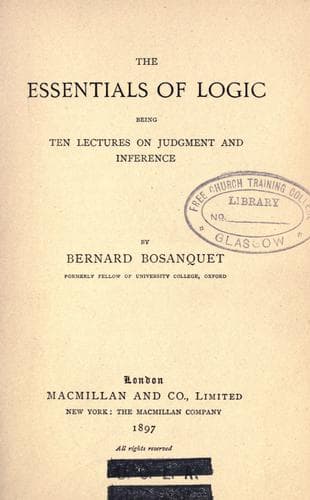
The Essentials of Logic, Being Ten Lectures on Judgment and InferenceBosanquet, Bernard
Philosophy
The Essentials of Logic, Being Ten Lectures on Judgment and Inference
Bosanquet, Bernard
Logic
subject that represents the real world, not to ourselves at all. When
I say “Gladstone comes to London this week,” the verb which expresses
Gladstone’s action also expresses that my real world in his person
accepts the qualification “coming to London this week.” Because of this
objectivity of thought, I attribute to {111} the real world and not to
myself the connection which is presented to my mind, and so it takes
its place as an act of the real world. But I might throw the whole
content into the Predicate by saying, “The ideal content ‘Gladstone
coming to London this week’ is a predication true of Reality.” Thus
though the distinction between Subject and Predicate best exhibits the
living structure of knowledge, we must beware of the notion that two
ideas or two things are needed for Judgment.
{112}
LECTURE VII THE CATEGORICAL AND HYPOTHETICAL CHARACTERS IN
JUDGMENT
_Some criticism on the ordinary scheme_ [1]
1. We will first consider why we want to examine the types of Judgment,
and then what arrangement of them best fulfils our want.
[1] Read Mill, ch. iv. (Bk. I.), on Propositions; Venn,
_Empirical Logic_, ch. ix., x. Cf. _Knowledge and Reality_ pp.
57-8; and Venn, p. 264. Ordinary statement, Jevons, p. 60, ff.;
cf. p. 163.
_Why we need an arrangement_
(_a_) If we attended purely to the propositions in common use, we
should get an unmanageable variety of forms, though the reality of
thought would be fairly represented. We cannot quite do this; we must
try to select the forms which for some reason are the most fundamental
and constant.
On the other hand, it is possible to think simply of what is convenient
in logical combination; and then for working with syllogistic Logic we
get the well-known scheme of four propositions, each with Subject and
Predicate; and for working with symbolic Logic we get the existential
scheme in which Subject and Predicate disappear, and “All S. are P.”
turns into “There exists no S. which is not P.”; or we get Jevons’
Equational Logic, in which “All A is B” stands as A = AB. Now every
Judgment has a great many aspects, {113} being really a very complex
systematic act of mind, and a logical method can be founded on any of
these aspects which is sufficiently constant to stand for the Judgment.
You can take “All men are mortal” to mean “There are no not-mortal
men,” or “Men = some mortals,” or two or three more meanings. The two
former are artificial or formal corollaries from the natural Judgment,
representing it for some purposes but omitting a great part of its
natural meaning. They tell you nothing about a relation of causality
between the content of man and the property mortal, and they destroy
all implication of existence in the Subject man.
Public-domain text, read in full here on John Shaqi.
Reviews
Reviews
No reviews yet
Be the first to share your thoughts on this work.
Elsewhere in the archive
Join the Discussion
Join the discussion
Sign in to leave a comment or review.
Sign InorCreate an account