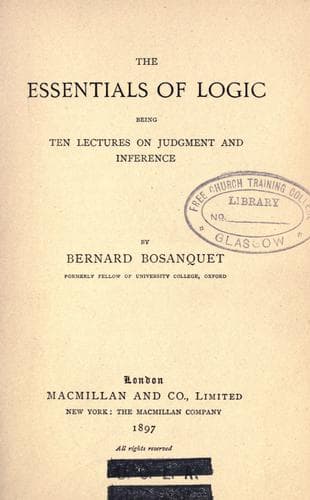
The Essentials of Logic, Being Ten Lectures on Judgment and InferenceBosanquet, Bernard
Philosophy
The Essentials of Logic, Being Ten Lectures on Judgment and Inference
Bosanquet, Bernard
Logic
What we want is neither to follow _mere_ everyday language, nor be
guided by mere convenience of logical combination. We want to look at
the Judgment on its merits with reference to its power of expressing
the principal kinds of our experience, which in fact are constructed in
the medium of Judgment. The great kingdoms of intellectual experience
are Perception, History, and Science, and of these three, Science,
including Philosophy, is the form towards which all knowledge presses
on, and its judgment must therefore be considered as the most complete
type.
_The common scheme_
(_b_) With this purpose in mind, let us look at the traditional scheme,
omitting the negative Judgments of which we have not yet spoken. We may
dismiss the Indefinite Judgment “Men are mortal” as imperfect by not
being “quantified,” and we have left, as Categorical Judgments, the
Particular Affirmative “Some men are mortal,” the Universal Affirmative
“All men are mortal,” and the Singular Affirmative “Socrates is
mortal.” The Singular Affirmative, however, is not treated of any
further under the old scheme, {114} because in it the Subject is taken
in its full extent, and therefore the Singular Affirmative Judgment is
ranked with the Universal Affirmative. So as Categorical Judgments we
have left the Particular Affirmative and the Universal Affirmative.
Outside the account of the Categorical Judgment we find the
Hypothetical and Disjunctive Judgments touched on as a sort of
Appendix, standing as “Conditional.” The historical reason of this
is, that they were not recognised by Aristotle, and have never been
incorporated in the diagram of judgments employed in traditional Logic.
Then on the ordinary scheme we have--
Categorical. Conditional.
Particular Universal Hypothetical Disjunctive
Judgments. Judgments, Judgments.
including
Singular
Judgments.
The defects of this scheme from our point of view are—
(i.) Our Impersonal and Demonstrative Judgments are omitted. They
_might_ be classed under the particular, which also has an undefined
element in the subject.
(ii.) The Singular Judgment (of which the chief instance is the
judgment with proper name) is rightly classed as Universal, but yet is
wrongly absorbed in the abstract universal, from which it ought to be
distinguished.
(iii.) In the treatment of the Universal Judgment there are two
defects—
(1) The Collective Judgment, resulting from enumeration, {115} direct
or indirect, is not distinguished from the Generic Judgment, resting
on a connection of content or presumption of causality. “All the [1]
papers have been looked over” should be distinguished from “All
triangles have their three angles equal to two right angles.”
Public-domain text, read in full here on John Shaqi.
Reviews
Reviews
No reviews yet
Be the first to share your thoughts on this work.
Elsewhere in the archive
Join the Discussion
Join the discussion
Sign in to leave a comment or review.
Sign InorCreate an account