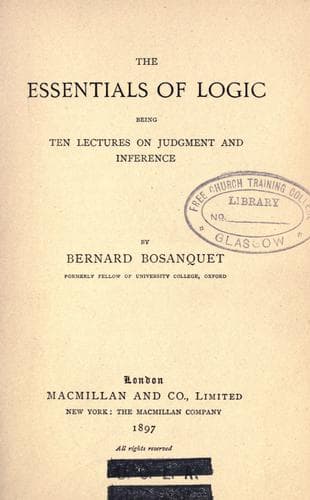
The Essentials of Logic, Being Ten Lectures on Judgment and InferenceBosanquet, Bernard
Philosophy
The Essentials of Logic, Being Ten Lectures on Judgment and Inference
Bosanquet, Bernard
Logic
[1] “The” as here used indeed practically = “these,” so
that, by our analysis, such a judgment has no claim to rank
as a universal judgment It is difficult to find a plainly
collective judgment which has not some affinity to judgment with
demonstrative pronoun or proper name. A judgment in which “All
M.P.’s” stands as subject, has affinity with the latter.
(2) The nature of the Universal Judgment is not examined with a view
to the distinction between Categorical and Hypothetical. The common
Logic does not go behind the grammatical form, which on this point is
not decisive.
(iv.) The Hypothetical Judgment [1] is said to consist of two
categorical propositions, or to be “_complex_” But of course it is a
simple judgment, _prima facie_ expressing a relation of reason and
consequent. Its parts are not Judgments, for they are not such as to
stand alone.
[1] Bain, p. 85; Jevons, p. 160.
(v.) The Disjunctive Judgment is often (_e.g._ by Mill and Bain) said
to be equivalent to two Hypothetical Judgments. The strange thing
is that both of these writers take the wrong two. [1] If we allow
conversion of a Hypothetical Judgment two are enough, but of course
they must be the two which cannot be got from each other by conversion,
viz. the two beginning, “If A is B ...” and “If A is not B ...”
respectively. If we do not admit conversion we must have all four.
Let the disjunction be, “This signal light is either red or green.”
In order to know this we must know not {116} only that, “If it is
red it is not green” (with its equivalent, “If it is green it is not
red”), but that, “If it is not red it is green” (with its equivalent,
“If it is not green it is red”). The former by itself leaves open the
possibility that it may be not red or green, but blue or yellow; the
latter by itself the possibility that when it is red it may also at
the same time be green. The former secures that the two terms exclude
each other; the latter, that, taken together, they exclude all other
predicates.
[1] Mill, ch. iv.; Bain, p. 86.
In any case, the disjunctive is more than any combination of
Hypotheticals, and really tends to be Categorical, and ought not to be
claimed as Conditional.
_Which are Categorical?_
2. We will now look at these Judgments in order, consider their real
meaning, and also ascertain the limits of the Categorical Judgment,
viz. that which affirms the existence of its Subject, or in other
words, asserts a fact.
_The Particular Judgment_
(i) The Particular Judgment of common Logic, “Some S. is P.,” has
different meanings according as it is understood naturally, or tied
down to be a result of enumeration.
In any case it is an imperfect, unscientific Judgment, in which the
mind cannot rest, because it has an undefined limitation imposed upon
the Subject.
_Its natural meaning_
Public-domain text, read in full here on John Shaqi.
Reviews
Reviews
No reviews yet
Be the first to share your thoughts on this work.
Elsewhere in the archive
Join the Discussion
Join the discussion
Sign in to leave a comment or review.
Sign InorCreate an account