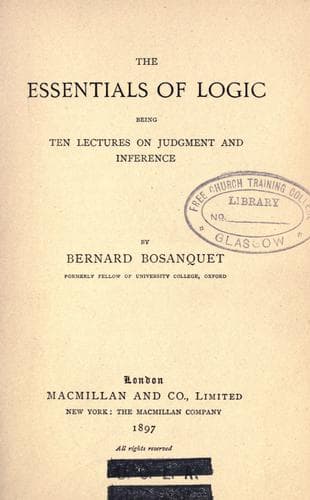
The Essentials of Logic, Being Ten Lectures on Judgment and InferenceBosanquet, Bernard
Philosophy
The Essentials of Logic, Being Ten Lectures on Judgment and Inference
Bosanquet, Bernard
Logic
(_a_) For the natural meaning, take the example, “Some engines can
drag a train at a mile a minute for a long distance.” [1] This does
not _mean_ a certain number of engines, though of course they _are_ a
certain number. It {117} means certain engines of a particular make,
not specified in the Judgment. The Judgment is Categorical, because
the undefined reservation implies a reference to something unanalysed,
but merely touched or presented in experience. If it was a mere idea
it would have to be clear; and if the full description or definition
were inserted, the Judgment would cease to affirm the existence of
the engines in question. _And the Judgment itself challenges this
completion._
[1] To be accurate, the Judgment would demand the insertion of
precise details about train, distance, and other matters. But
this illustrates the point of the text, because the assignment
of such details would naturally extend to the Subject, and then
the “Some” would be displaced.
_A narrower meaning_
(_b_) A more artificial meaning is to take the Judgment as not formed
by imperfect description, but by imperfect enumeration (understanding
it almost wholly in denotation). “Some Conservatives are in favour
of women’s suffrage.” This means or may mean that we have counted a
certain number, large or small, who are so, and we may or may not know
about the others. _Thus understood, the Judgment challenges complete
enumeration_; it contains of course the elements of a fraction--half,
most, nine-tenths of, and so on.
This again is Categorical; not merely because it implies counting, but
because it implies counting units separately given to experience.
The Particular Judgment does not include our Impersonal and
Demonstrative Judgments; they are not classed in the common text-books.
But as referring to perception they too are categorical and assert
facts, whether they have ideas to help out the perceptive reference or
not. And there is no reason against including them under the Particular
Judgment. The assertion, “This engine can drag a train a mile a
minute,” is much the same kind of Judgment as, “Some engines can, etc.”
Either of these would be false {118} if no such engines existed. _These
Judgments are of the essence of perception_. They have the connection
of content and the undefined complex of presentation struggling
together in them. They assert fact.
_Singular Judgment_
Public-domain text, read in full here on John Shaqi.
Reviews
Reviews
No reviews yet
Be the first to share your thoughts on this work.
Elsewhere in the archive
Join the Discussion
Join the discussion
Sign in to leave a comment or review.
Sign InorCreate an account