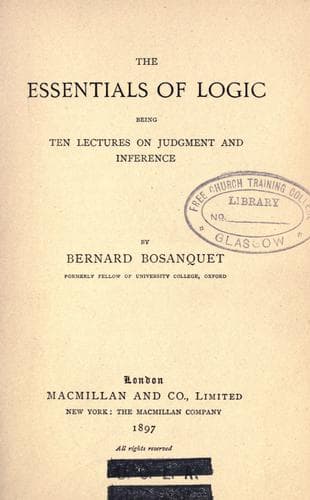
The Essentials of Logic, Being Ten Lectures on Judgment and InferenceBosanquet, Bernard
Philosophy
The Essentials of Logic, Being Ten Lectures on Judgment and Inference
Bosanquet, Bernard
Logic
(2) The Singular Judgment of the common Logic is pretty much our
Judgment with a proper name, which I call Individual, and which, as we
saw, is in part rightly called universal--because the Subject extends
beyond perception, and the Predicate follows the Subject. But it is
a concrete or individual Universal, not an abstract Universal, and
therefore asserts the existence of its Subject. The reason why it is
taken to assert the reality of its Subject must be, I suppose, that
it _can_ assert this, its Subject being a name for an existence that
has limited reality within the temporal series, and _cannot_ assert
anything else, not having any general fixed content or connotation
which could imply a _general_ connection of Subject and Predicate. The
general connection of content which is so fatal to the asserting of
fact does not exist in this case. We see this in Mill’s instance. “The
summit of Chimborazo is white,” When the Subject is a unique name with
precise connotation, “The centre of gravity of the material universe
is variable,” then we are passing into the abstract Universal, and I
think we may take such a Judgment perhaps as one of the best examples
of a conjunction of categorical and hypothetical meaning, _i.e._ of
a connection of content ascribed to a Subject affirmed to exist. But
usually one meaning or the other is uppermost.
These Judgments, called Singular or Individual, correspond to the
region of history or narrative. The realities {119} with which they
deal have their definite position in a single system of time and space,
and this is often made emphatic by the use of tenses. But these change
with the date relative to the speaker, so that a Judgment with real
tense must once have been false, or must become false by lapse of
time. Thus the Judgment of fact may be not absolutely true. Nothing is
genuinely true which a change of date can make false. The permanently
true time-relations between Subject and Predicate are determined by
their content, and the copula is not a tense, but a mere sign of
affirmation. The Singular as Categorical is sharply distinguished from
the Abstract Universal, with which common Logic classes it.
_Universal Judgment_
(3) Down to this point the judgment states a _fact_. When we come to
the ordinary universal affirmative, we see at once that it may express
very different meanings. In its natural meaning it strongly _implies_
that its Subject has a particular existence within the series of time
and space, but hardly asserts it.
_Import of Propositions_
Public-domain text, read in full here on John Shaqi.
Reviews
Reviews
No reviews yet
Be the first to share your thoughts on this work.
Elsewhere in the archive
Join the Discussion
Join the discussion
Sign in to leave a comment or review.
Sign InorCreate an account