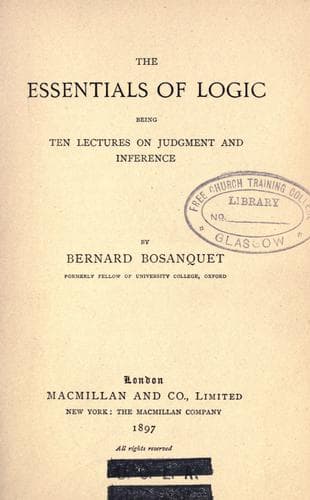
The Essentials of Logic, Being Ten Lectures on Judgment and InferenceBosanquet, Bernard
Philosophy
The Essentials of Logic, Being Ten Lectures on Judgment and Inference
Bosanquet, Bernard
Logic
Mill, for example, says “the objects are no longer individually
designated, they are pointed out only by their attributes;” “most of
them not known individually at all.” That means that the explicit
Subject is not made of individuals. The natural meaning is disputed; I
incline to think with Venn, that the Subject is naturally taken _more_
in Denotation (not solely, which is unmeaning), and the Predicate
_more_ in connotation. But clearly in literal form the Subject is
simply a significant idea, and its existence in things or events is
not affirmed though it may be strongly implied. Hamilton [1] {120}
says quite calmly--“‘Rainy weather is wet weather’ is a Categorical
Proposition; ‘If it rains it will be wet’ is Hypothetical.” Between
the two I can see no distinction of meaning at all. [2] If indeed we
take the Universal Affirmative in the pure sense of aggregate formed
by enumeration, and therefore finite, it _may_ be said that we assert
the existence of the individuals composing it; but this is a very
unreal view of the meaning of the Judgment (though suggested by its
customary form), and even then it would be hard to prove that we
continue to think of the Subject as individuals. This reference to
a finite aggregate makes the _Collective Judgment_ or _Judgment of
Allness_. It cannot really exist in the case of a class like man, of
unknown extension, and is confined, at its widest, to such cases as
“All present Members of Parliament have to take a line on the Irish
question.” This _might_ be Categorical, but need not be so.
[1] _Lectures_, vol, iii. p. 327.
[2] Contrast Jevons, _Elementary Logic_, p. 163.
Otherwise, the Universal Affirmative of common Logic is literally
Hypothetical, though in some cases it may strongly imply the assertion
of reality. Dr. Venn has discussed this question. [1] He says the
implication of existence is much stronger with a single-word Subject
than with a many-worded Subject; _i.e._ perhaps with a natural than
with an artificial conception. But in any case, the expressed bond with
perception is lost, and in pure form the Subject is a mere abstract
idea, so that the relations of content entirely predominate over the
implication of existence.
[1] _Empirical Logic_, pp. 258-9.
Thus the Universal Affirmative in its full meaning fairly {121}
represents the sciences of classification, combining a subordinate
meaning of Allness or numerical totality with a primary meaning of
connotation of attributes or presumed causality. When we say “All the
Buttercup family have an inferior corolla,” of course we mean that
there is a reason for this. Often we omit the term all, as in “Heat
is a mode of motion.” In doing this we wipe out the last trace of a
reference to individual objects, and we pass to the pure hypothetical
form which absolutely neglects the existence of objects.
_“Hypothetical” Judgment_
Public-domain text, read in full here on John Shaqi.
Reviews
Reviews
No reviews yet
Be the first to share your thoughts on this work.
Elsewhere in the archive
Join the Discussion
Join the discussion
Sign in to leave a comment or review.
Sign InorCreate an account