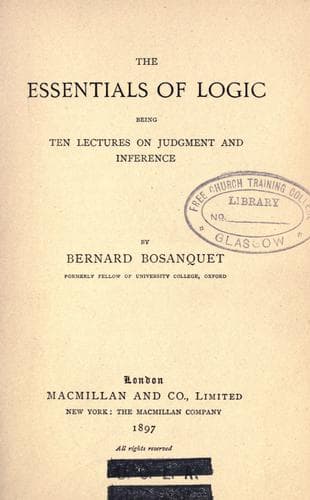
The Essentials of Logic, Being Ten Lectures on Judgment and InferenceBosanquet, Bernard
Philosophy
The Essentials of Logic, Being Ten Lectures on Judgment and Inference
Bosanquet, Bernard
Logic
(4) The simplest type of this Judgment is, if A is B it is C. This
Judgment corresponds to abstract science, but it is only making
explicit what was implied in the Universal Affirmative. That
expressed a presumption of causality, this expresses a clear Reason
and Consequent or scientific necessity. The point of this form is
(i.) that it drops all reference to individual objects, (ii.) that
it challenges you to explain how the Subject-content is tied to the
Predicate-content. “Water boils at 212°,” is a statement we should
generally pass in so-called Categorical form, because it does not
challenge any great accuracy of connection. But “If water boils, it
is at a temperature of 212°,” puts us upon asking, “Is the condition
adequate?” and we see at once that we must at least say, “If water
boils _under pressure of one atmosphere_, it is at a temperature of
212°,” or else the judgment is untrue. Of course we may apply the form
rightly or wrongly, as you may fill up your census paper rightly or
wrongly. We can only say that it calls upon you to put in an adequate
condition. Therefore I rather object to the form “If A is, B is,”
because it adds very little to the so-called Categorical shape.
{122} We have now to ask how the Hypothetical Judgment connects its
content with reality, _i.e._ how it is a Judgment at all? And the same
explanation must apply to so-called Categorical Judgments, which can be
thrown into this form without change of meaning.
The point from which the explanation starts is taking hypothesis as
supposition. This is much more true, I think, than connecting it with
_doubt_. In Dr. Venn’s _Empirical Logic_ the connection of Hypothetical
Judgment and doubt to my mind disfigures the whole treatment of the
Scientific Judgment. Supposition is distinct from affirmation--that
is true--but just because it is distinct from affirmation, it cannot
indicate doubt. It probably arose out of doubt, but as a method of
science it does not imply doubt, but only the accurate limitation of
attention. What doubt is there when we judge “If equals be added to
equals, the wholes are equal”? We are attending to one particular
thread of the nexus.
Hypothetical Judgment, then, is Judgment that starts from a
supposition. Every supposition is made upon a certain basis of
Reality. Take as an extreme case, “If you ask permission of A.B., he
will refuse it.” This is a supposition and its result, on the basis
of the known character of A.B. And the full judgment is “A.B. is of
such a character, that, supposing you ask him for permission, etc.”
The Hypothetical Judgment may be true, as an assertion about A.B.’s
character, though you may never ask.
Public-domain text, read in full here on John Shaqi.
Reviews
Reviews
No reviews yet
Be the first to share your thoughts on this work.
Elsewhere in the archive
Join the Discussion
Join the discussion
Sign in to leave a comment or review.
Sign InorCreate an account