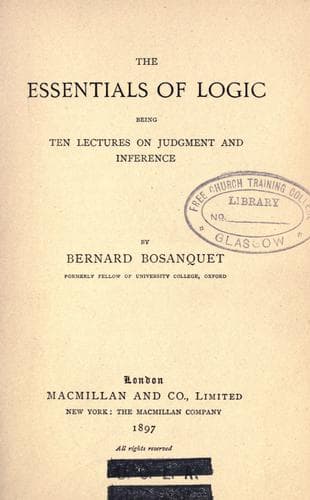
The Essentials of Logic, Being Ten Lectures on Judgment and InferenceBosanquet, Bernard
Philosophy
The Essentials of Logic, Being Ten Lectures on Judgment and Inference
Bosanquet, Bernard
Logic
I pause to say that the proof of the exhaustiveness of negation, _i.e._
that two negatives make an affirmative--that if A is not not-B, it
follows that A is B--is a disputed problem, the problem known as double
negation. How do you know that what is not not-red must be red? I take
the law of Excluded Middle simply as a definition of the bare form
of denial, or the distinction between this and not-this; “not-this”
being the bare abstraction of the other than this. Others say that
every negation presupposes an affirmation; so “A is not-B” presupposes
the affirmation “A is B,” and {132} if you knock down the negative,
the original affirmative is left standing. Sigwart and B. Erdmann say
this. I think it monstrous. I do not believe that you must find an
affirmative standing before you can deny.
_Stage of Significant Negation. Combination of Contrary and
Contradictory_
4. Well, then, the point we have reached is this. What we mean in
denial is always the contrary, something positive. What we say
in denial--in other words, the literal form which we use--always
approaches the contradictory, _i.e._ is pure exclusion. The Contrary
of the diagram denies more than it need, but still its form is that
of exclusion. Now we have seen that in denial, as used in common
speech, we get the benefit of _both affirmation and exclusion_, but in
accurate thought we want to do much more than this; we want to get the
whole benefit of the negative form--that is, to get a positive meaning
together with not only exclusion, but exhaustion.
I will put the three cases in one example, beginning with mere
affirmations of different facts.
_Different Affirmations_
(1) “He goes by this train to-day.” “He goes by that train to-morrow.”
This conjunction, as simply stated, gives no inference from the truth
or falsehood of either statement to the truth or falsehood of the other.
_Contrary Opposition, exclusive_
(2) “He goes by this train,” and “He goes by that train,” with a
meaning equivalent to “No, he goes by that.” If it is true that in
the sense suggested by the context he goes by this train, then it is
not true that he goes by the other, and if it is true, in the sense
explained, that he goes by the other, then he does not go by this. Each
excludes the other, but both may be excluded by a third alternative.
If it is _not_ true that he goes by this {133} train--nothing follows.
There may be any number of trains he might go by, or he might give up
going; _i.e._ your Universe of discourse, your implicit meaning is
not expressly limited. If it is _not_ true to say, “No, he goes by
that”--taking the whole meaning together, and not separating its parts,
for this combination is essential to the “contrary”--nothing follows as
to the truth of the other statement. He may not be going at all, or may
be going by some third train, or by road.
_Combined Contrary and Contradictory Negation_
Public-domain text, read in full here on John Shaqi.
Reviews
Reviews
No reviews yet
Be the first to share your thoughts on this work.
Elsewhere in the archive
Join the Discussion
Join the discussion
Sign in to leave a comment or review.
Sign InorCreate an account