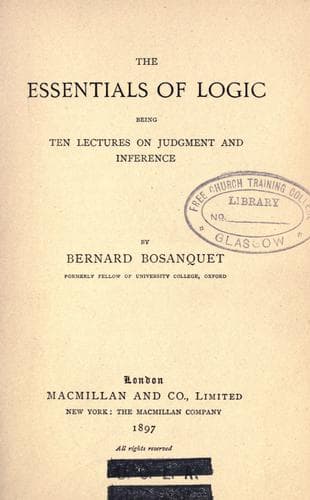
The Essentials of Logic, Being Ten Lectures on Judgment and InferenceBosanquet, Bernard
Philosophy
The Essentials of Logic, Being Ten Lectures on Judgment and Inference
Bosanquet, Bernard
Logic
But if you limit your Universe, or general subject, then you can
combine the value of contrary and contradictory negation. Then you say,
(3) “He goes either by this train or by that.” Then you can infer not
only from “He goes by this train,” that “He does not go by that,” but
from “He does not go by this train” to “He does go by that.”
The alternative between “A is B” and “A is not-B” remains exhaustive,
but not-B has been given a positive value, _because we have limited
the possibilities by definite knowledge_. The processes of accurate
thinking and observation aim almost entirely at giving a positive value
C to not-B, and a positive value B to not-C, under a disjunction,
because it is then that you define exactly where and within what
conditions C which is not B passes into B which is not C. Take the
disjunction, “Sound is either musical or noise.” If the successive
vibrations are of a uniform period it is musical sound; if they are of
irregular periods it is noise. This is a disjunction which assumes the
form,
A is either B or C. That is to say, If it is B it is not C. If it is
not B it is C.
{134} Therefore I think that all “determination is negation”--of
course, however, not bare negation, but significant negation; the
essence of it consists in correcting and confirming our judgment of
the nature of a positive phenomenon by showing that _just when_ its
condition ceases, _just then_ something else begins, and when you have
exhausted the whole operation of the system of conditions in question,
so that from any one phase of their effects you can read off what _it_
is not but the _others_ are, then you have almost all the knowledge
we can get. The “_Just-not_” is the important point, and this is only
given by a positive negation within a definite system. You want to
explain or define the case in which A becomes B. You want observation
of not-B; but almost the whole world is formally or barely not-B, so
that you are lost in chaos. What you must do is to find the point
within A, where A1 which is B passes into A2 which is C, and that will
give you the _just-not-B_ which is the valuable negative instance.
_Negative judgment expressing fact_
Public-domain text, read in full here on John Shaqi.
Reviews
Reviews
No reviews yet
Be the first to share your thoughts on this work.
Elsewhere in the archive
Join the Discussion
Join the discussion
Sign in to leave a comment or review.
Sign InorCreate an account