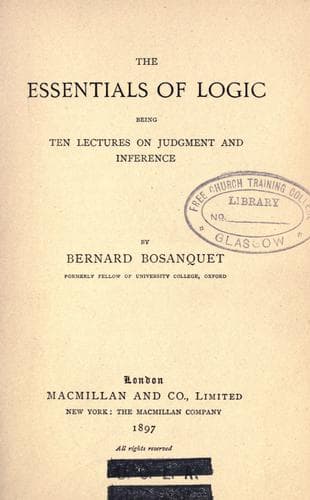
The Essentials of Logic, Being Ten Lectures on Judgment and Inference — John Shaqi
The Essentials of Logic, Being Ten Lectures on Judgment and InferenceBosanquet, Bernard
Philosophy
The Essentials of Logic, Being Ten Lectures on Judgment and Inference
Bosanquet, Bernard
Logic
ii. In describing the second position as that of common-sense theory
I do not refer to the doctrine of any regular school of philosophers.
There was a Scotch school of philosophy--the school of Reid in the
eighteenth century--commonly called the common-sense school. I will say
{9} below how I think this school was related to the position which
I am now describing. But my present purpose is to hit off the simple
theory of reality which common-sense people make for themselves when
they reflect. Now this theory, in which we all live except when we make
a special effort, accepts the distinction between things and the mind.
For example, it defines truth as the conformity of ideas to objects.
That means something of this kind: the ideas are inside our heads,
and the objects are outside our heads. If we are to have knowledge,
the objects have to be represented inside our heads, and they get in
through the senses. And then you have two similar forms of the world,
one outside our heads, which is real, and another like it but less
perfect and without solidity or causal power, inside our heads, which
is ideal or mental. This is what I call the common-sense theory of the
Objective. Like common sense, it assumes that there is a world which
the withdrawal of our individual consciousness does not affect, but
which persists and acts all the same. Unlike common sense, it lays down
an assertion as to the nature of this world, viz. that it is, apart
from our consciousness, the same as it is for our consciousness. The
world in consciousness, it assumes, is subjective, the world out of
consciousness is objective, and the former is an imperfect copy of the
latter in a feebler material.
The schools of common-sense philosophy, such as are represented by
Locke and Reid, are not quite so simple-minded as the reflection of
ordinary common sense, because every systematic thinker sees at once
that the question stares him in the face, “If the world outside the
mind is copied {10} by the world inside the mind, how can we ever know
whether the copy conforms to the original?” We are by the hypothesis
inside the mind; whatever has passed through the senses is inside the
mind. We cannot as at present advised get at anything outside the
senses or outside the mind. In face of this question, the common-sense
philosophies have two courses open. They may start from the idea of
things outside the mind, but admit that in passing through the senses
the things are in some partial respects transformed--as for instance,
that they acquire colour, sound, and smell in passing through the
senses--this is what Locke says. Or again, still starting from the idea
of things outside the mind, they may simply assert that perception
is of such a nature that it gives us things as they really are. The
former was the view of Locke, the latter that of Reid. This latter
view obviously might pass into the most extreme idealism, and its
interpretation, if it does not so pass, is exceedingly difficult.
Public-domain text, read in full here on John Shaqi.
Reviews
Reviews
No reviews yet
Be the first to share your thoughts on this work.
Join the Discussion
Join the discussion
Sign in to leave a comment or review.
Sign InorCreate an account