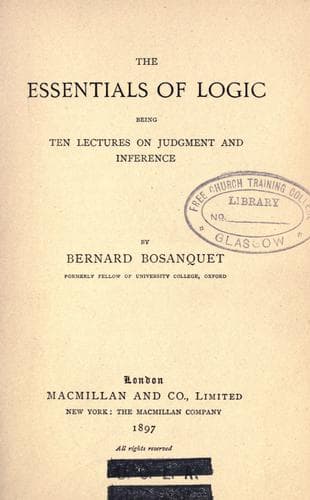
The Essentials of Logic, Being Ten Lectures on Judgment and InferenceBosanquet, Bernard
Philosophy
The Essentials of Logic, Being Ten Lectures on Judgment and Inference
Bosanquet, Bernard
Logic
5. You will find it said that a Negative Judgment cannot express fact;
_e.g._ that a Judgment of Perception cannot be negative. This is worth
reflecting upon; I hope that what has been said makes clear how far it
is true. The bare form of Negation is not adequate to fact; it contains
mere emptiness or ignorance; we nowhere in our perception come upon a
mere “not-something.” No doubt negation is in this way more subjective
than affirmation. But then as it fills up in meaning, the denial
becomes more and more on a level with the affirmation, till at last
in systematic knowledge both become double-edged--every affirmative
denies, and every negative affirms. When a man who is both a {135}
musician and a physicist says, “this compound tone A is a discord Y,”
he knows exactly how much of a discord, what ratio of vibration makes
it so much of a discord, how much it would have to change to become a
concord (X which is not Y), and what change in the vibration ratio from
a1 to a2 would be needed to make it a concord. To such knowledge as
this, the accurate negation is just as expressive as the affirmation,
and it does not matter whether he says “A is Y,” or “A is by so much
not X.” It becomes, as Venn says, all but impossible to distinguish the
affirmation from the negation. No doubt affirmative terms come in at
this stage, though the meaning is negative. Observe in this connection
how we sometimes use the nearest word we can think of, knowing that the
negative gives the positive indirectly--“He was, I won’t say insolent,”
meaning _just not_ or “_all but_” insolent; or again, “That was not
right,” rather than saying bluntly “wrong.”
_Operation of the denied idea_
6. Every significant negation “A is not B” can be analysed as “A is X
which excludes B.” Of course X may not be a distinct C; _e.g._ we may
be able to see that A is not red, but we may not be able to make out
for certain what colour it is; then the colour X is “an unknown colour
which excludes red.”
How does the rejected idea operate in Judgment? I suppose it operates
by suggesting a Judgment which as you make it destroys some of its
own characteristics. It is really an expression of the confirmatory
negative instance or “just-not.” _Just_ when two parallel straight
lines swing so that they can meet, _just_ then the two interior angles
begin to be less than two right angles, which tells us that the {136}
straight lines are ceasing to be parallel. Just in as much as two
straight lines begin to enclose a space we become aware that one or
other of them is not straight, so that A in turning from Y to X turns
_pari passu_ from A1 to A2, and we are therefore justified in saying
that A, when it is Y, cannot be X.
This lecture may pave the way for Induction, by giving some idea of the
importance of the negative instance which Bacon preached so assiduously.
Public-domain text, read in full here on John Shaqi.
Reviews
Reviews
No reviews yet
Be the first to share your thoughts on this work.
Elsewhere in the archive
Join the Discussion
Join the discussion
Sign in to leave a comment or review.
Sign InorCreate an account