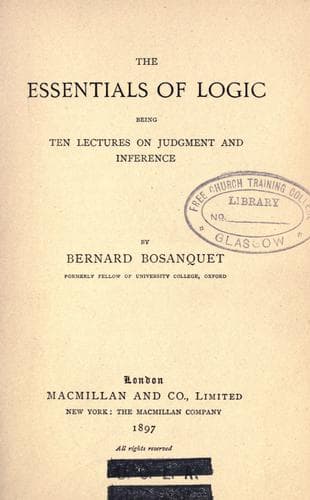
The Essentials of Logic, Being Ten Lectures on Judgment and InferenceBosanquet, Bernard
Philosophy
The Essentials of Logic, Being Ten Lectures on Judgment and Inference
Bosanquet, Bernard
Logic
In a real system of science the conceptions are negative towards each
other merely as defining each other. One of them is not in itself
more negative than another. Such a conception, _e.g._, is that of a
triangle compared with two parallel straight lines which are cut by
a third line. If the parallels are swung so as to meet, they become
a triangle which gains in its third angle what the parallels lose on
the two interior angles, and the total of two right angles remains
the same. Thus in saying that parallels cut by a third straight line
cannot form a triangle, and that the three angles of a triangle are
equal to two right angles, we are expressing the frontier which is at
once the demarcation between two sets of geometrical relations, and the
positive grasp or connection of the one with the other. The negation is
no bar to a positive continuity in the organism of the science, but is
essential to defining its nature and constituent elements. This is the
bearing of significant negation when fully developed.
{137}
LECTURE IX INFERENCE AND THE SYLLOGISTIC FORMS
_Inference in general_ [1]
1. The Problem of Inference is something of a paradox. Inference
consists in asserting as fact or truth, on the ground of certain given
facts or truths, something which is not included in those data. We
have not got inference unless the conclusion, (i.) is necessary from
the premisses, and (ii.) goes beyond the premisses. To put the paradox
quite roughly--we have not got inference unless the conclusion is (i.)
in the premisses, and (ii.) outside the premisses. This is the problem
which exercises Mill so much in the chapter, “Function and Value of the
Syllogism.” We should notice especially his § 7, “the universal type
of the reasoning process.” The point of it is to make the justice of
inference depend upon relations of content, which are judged of by what
he calls induction. That is quite right, but the question still returns
upon us, “What kind of relations of content must we have, in order to
realise the paradox of Inference?” This the “type of inference” rather
shirks. See Mill’s remarks when he is brought face to face with {138}
Induction, Bk. III. ch. f. § 2. An Inference, as he there recognises,
either does not hold at all, or it holds “in all cases of a certain
description,” _i.e._, it depends on universals.
[1] Read for Lectures IX. and X., Mill, Bk. II ch. i., ii.,
iii.; Bk. III. ch. i. and ii. at least; Venn, ch. xiv., xv.;
Jevons, _Lessons_ xv. and xxiv.; De Morgan’s _Budget of
Paradoxes_.
Public-domain text, read in full here on John Shaqi.
Reviews
Reviews
No reviews yet
Be the first to share your thoughts on this work.
Elsewhere in the archive
Join the Discussion
Join the discussion
Sign in to leave a comment or review.
Sign InorCreate an account