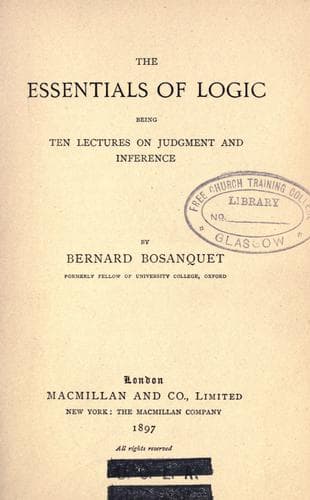
The Essentials of Logic, Being Ten Lectures on Judgment and InferenceBosanquet, Bernard
Philosophy
The Essentials of Logic, Being Ten Lectures on Judgment and Inference
Bosanquet, Bernard
Logic
I ought to warn you at once that though we may have novelty in the
conclusion of Inference (as in multiplication of large numbers),
the necessity is more essential than the novelty. In fact, much of
Inference consists in demonstrating the _connection_ of matters that
as _facts_ are pretty familiar. Of course, however, they are always
modified in the process, and in that sense there is always novelty. You
obtain the most vital idea of Inference by starting from the conclusion
as a suggestion, or even as an observation, and asking yourself how it
is proved, or explained, and treating the whole process as a single
mediate judgment, _i.e._ a reasoned affirmation. Take the observation,
“The tide at new and full moon is exceptionally high.” In scientific
inference this is filled out by a middle term. We may profitably think
of the “middle term,” as the copula or grip which holds the conclusion
together, made explicit and definitely stated. Thus the judgment pulls
out like a telescope, exhibiting fresh parts within it, as it passes
into inference. “The tide at new and full moon, _being at these times
the lunar tide plus the solar tide_, is exceptionally high.” This is
the sort of inference which is really commonest in science. Such an
inference would no doubt give us the conclusion if we did not know it
by observation, but it happens in many cases that we do know it by
observation, and what the inference gives us is the connection, which
of course may enable us to correct the observation.
{139} _Conditions of the possibility of Inference_
2. In the strictest formal sense there can be no inference from
particulars to particulars. When there seems to be such inference, it
is merely that the ground of inference is not mentioned, sometimes
because it is obvious, sometimes because it is not clearly specified
in the mind. Suppose we say, “Morley and Harcourt will go for
Disestablishment, and I think, therefore, that Gladstone will.” I do
not _express_ any connecting link, merely because every one sees at
once that I am inferring from the intentions of some Liberal leaders to
those of another. If the terms are really particulars, “X is A, Y is B,
Z is C,” one is helpless; they do not point to anything further at all;
there is no bridge from one to the other.
Inference cannot possibly take place except through the medium of an
identity or universal which acts as a bridge from one case or relation
to another. If each particular was shut up within itself as in the
letters taken as an instance just now, you could never get from one
which is given to another which is not given, or to a connection not
given between two which are given.
Public-domain text, read in full here on John Shaqi.
Reviews
Reviews
No reviews yet
Be the first to share your thoughts on this work.
Elsewhere in the archive
Join the Discussion
Join the discussion
Sign in to leave a comment or review.
Sign InorCreate an account