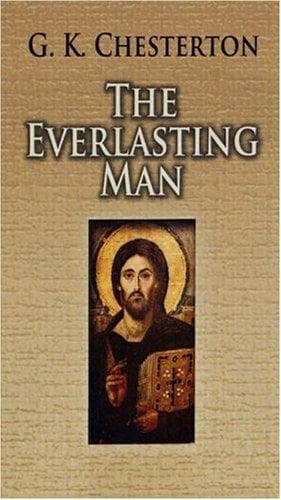
The Everlasting ManChesterton, G. K. (Gilbert Keith)
Religion
The Everlasting Man
Chesterton, G. K. (Gilbert Keith)
Catholic Church -- Apologetic works; Christianity and other religions; Religion
So also in the specially Christian case we have to react against the
heavy bias of fatigue. It is almost impossible to make the facts vivid,
because the facts are familiar; and for fallen men it is often true that
familiarity is fatigue. I am convinced that if we could tell the
supernatural story of Christ word for word as of a Chinese hero, call
him the Son of Heaven instead of the Son of God, and trace his rayed
nimbus in the gold thread of Chinese embroideries or the gold lacquer of
Chinese pottery instead of in the gold leaf of our own old Catholic
paintings, there would be a unanimous testimony to the spiritual purity
of the story. We should hear nothing then of the injustice of
substitution or the illogicality of atonement, of the superstitious
exaggeration of the burden of sin or the impossible insolence of an
invasion of the laws of nature. We should admire the chivalry of the
Chinese conception of a god who fell from the sky to fight the dragons
and save the wicked from being devoured by their own fault and folly.
We should admire the subtlety of the Chinese view of life, which
perceives that all human imperfection is in very truth a crying
imperfection. We should admire the Chinese esoteric and superior wisdom,
which said there are higher cosmic laws than the laws we know; we
believe every common Indian conjurer who chooses to come to us and talk
in the same style. If Christianity were only a new oriental fashion, it
would never be reproached with being an old and oriental faith. I do not
propose in this book to follow the alleged example of St. Francis Xavier
with the opposite imaginative intention, and turn the Twelve Apostles
into Mandarins; not so much to make them look like natives as to make
them look like foreigners. I do not propose to work what I believe would
be a completely successful practical joke; that of telling the whole
story of the Gospel and the whole history of the Church in a setting of
pagodas and pigtails; and noting with malignant humour how much it was
admired as a heathen story in the very quarters where it is condemned as
a Christian story. But I do propose to strike wherever possible this
note of what is new and strange, and for that reason the style even on
so serious a subject may sometimes be deliberately grotesque and
fanciful. I do desire to help the reader to see Christendom from the
outside in the sense of seeing it as a whole, against the background of
other historic things; just as I desire him to see humanity as a whole
against the background of natural things. And I say that in both cases,
when seen thus, they stand out from their background like supernatural
things. They do not fade into the rest with the colours of
impressionism; they stand out from the rest with the colours of
heraldry; as vivid as a red cross on a white shield or a black lion on a
ground of gold. So stands the Red Clay against the green field of
nature, or the White Christ against the red clay of his race.
Public-domain text, read in full here on John Shaqi.
Reviews
Reviews
No reviews yet
Be the first to share your thoughts on this work.
Join the Discussion
Join the discussion
Sign in to leave a comment or review.
Sign InorCreate an account