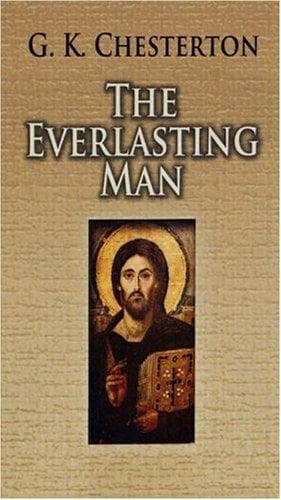
The Everlasting ManChesterton, G. K. (Gilbert Keith)
Religion
The Everlasting Man
Chesterton, G. K. (Gilbert Keith)
Catholic Church -- Apologetic works; Christianity and other religions; Religion
In this example, which I have taken merely because it is an example, it
will be noted that I do not say that the nightmare seen by the first man
of the forest is either more true or more wonderful than the normal mare
of the stable seen by the civilised person who can appreciate what is
normal. Of the two extremes, I think on the whole that the traditional
grasp of truth is the better. But I say that the truth is found at one
or other of these two extremes, and is lost in the intermediate
condition of mere fatigue and forgetfulness of tradition. In other
words, I say it is better to see a horse as a monster than to see it
only as a slow substitute for a motor-car. If we have got into _that_
state of mind about a horse as something stale, it is far better to be
frightened of a horse because it is a good deal too fresh.
Now, as it is with the monster that is called a horse, so it is with the
monster that is called a man. Of course the best condition of all, in my
opinion, is always to have regarded man as he is regarded in my
philosophy. He who holds the Christian and Catholic view of human nature
will feel certain that it is a universal and therefore a sane view, and
will be satisfied. But if he has lost the sane vision, he can only get
it back by something very like a mad vision; that is, by seeing man as a
strange animal and realising how strange an animal he is. But just as
seeing the horse as a prehistoric prodigy ultimately led back to, and
not away from, an admiration for the mastery of man, so the _really_
detached consideration of the curious career of man will lead back to,
and not away from, the ancient faith in the dark designs of God. In
other words, it is exactly when we do see how queer the quadruped is
that we praise the man who mounts him; and exactly when we do see how
queer the biped is that we praise the Providence that made him.
In short, it is the purpose of this introduction to maintain this
thesis: that it is exactly when we do regard man as an animal that we
know he is not an animal. It is precisely when we do try to picture him
as a sort of horse on its hind legs that we suddenly realise that he
must be something as miraculous as the winged horse that towered up into
the clouds of heaven. All roads lead to Rome, all ways lead round again
to the central and civilised philosophy, including this road through
elfland and topsyturvydom. But it may be that it is better never to have
left the land of a reasonable tradition, where men ride lightly upon
horses and are mighty hunters before the Lord.
Public-domain text, read in full here on John Shaqi.
Reviews
Reviews
No reviews yet
Be the first to share your thoughts on this work.
Join the Discussion
Join the discussion
Sign in to leave a comment or review.
Sign InorCreate an account