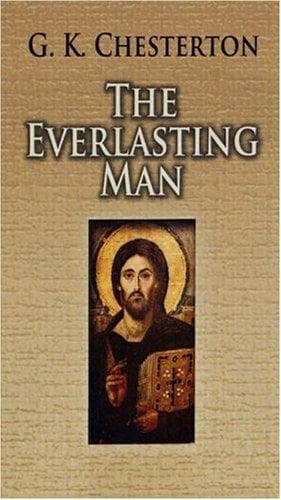
The Everlasting ManChesterton, G. K. (Gilbert Keith)
Religion
The Everlasting Man
Chesterton, G. K. (Gilbert Keith)
Catholic Church -- Apologetic works; Christianity and other religions; Religion
in which one really destroyed the other, and there was never any
combination in which one was really reconciled with the other. They
certainly did not work together; if anything the philosopher was a
rival of the priest. But both seemed to have accepted a sort of
separation of functions and remained parts of the same social system.
Another important tradition descends from Pythagoras; who is significant
because he stands nearest to the Oriental mystics who must be considered
in their turn. He taught a sort of mysticism of mathematics, that number
is the ultimate reality; but he also seems to have taught the
transmigration of souls like the Brahmins; and to have left to his
followers certain traditional tricks of vegetarianism and water-drinking
very common among the eastern sages, especially those who figure in
fashionable drawing-rooms, like those of the later Roman Empire. But in
passing to eastern sages, and the somewhat different atmosphere of the
East, we may approach a rather important truth by another path.
One of the great philosophers said that it would be well if philosophers
were kings, or kings were philosophers. He spoke as of something too
good to be true; but, as a matter of fact, it not unfrequently was true.
A certain type, perhaps too little noticed in history, may really be
called the royal philosopher. To begin with, apart from actual royalty,
it did occasionally become possible for the sage, though he was not what
we call a religious founder, to be something like a political founder.
And the great example of this, one of the very greatest in the world,
will with the very thought of it carry us thousands of miles across the
vast spaces of Asia to that very wonderful and in some ways that very
wise world of ideas and institutions, which we dismiss somewhat cheaply
when we talk of China. Men have served many very strange gods; and
trusted themselves loyally to many ideals and even idols. China is a
society that has really chosen to believe in intellect. It has taken
intellect seriously; and it may be that it stands alone in the world.
From a very early age it faced the dilemma of the king and the
philosopher by actually appointing a philosopher to advise the king. It
made a public institution out of a private individual, who had nothing
in the world to do but to be intellectual. It had and has, of course,
many other things on the same pattern. It creates all ranks and
privileges by public examination; it has nothing that we call an
aristocracy; it is a democracy dominated by an intelligentsia. But the
point here is that it had philosophers to advise kings; and one of those
philosophers must have been a great philosopher and a great statesman.
Public-domain text, read in full here on John Shaqi.
Reviews
Reviews
No reviews yet
Be the first to share your thoughts on this work.
Elsewhere in the archive
Join the Discussion
Join the discussion
Sign in to leave a comment or review.
Sign InorCreate an account