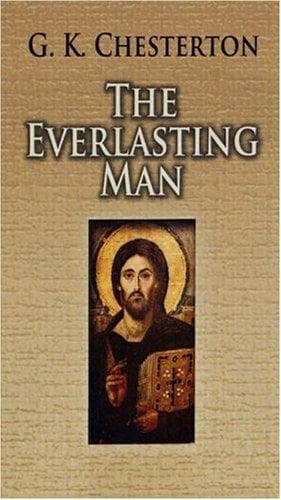
The Everlasting ManChesterton, G. K. (Gilbert Keith)
Religion
The Everlasting Man
Chesterton, G. K. (Gilbert Keith)
Catholic Church -- Apologetic works; Christianity and other religions; Religion
Confucius was not a religious founder or even a religious teacher;
possibly not even a religious man. He was not an atheist; he was
apparently what we call an agnostic. But the really vital point is that
it is utterly irrelevant to talk about his religion at all. It is like
talking of theology as the first thing in the story of how Rowland Hill
established the postal system or Baden Powell organised the Boy Scouts.
Confucius was not there to bring a message from heaven to humanity, but
to organise China; and he must have organised it exceedingly well. It
follows that he dealt much with morals; but he bound them up strictly
with manners. The peculiarity of his scheme, and of his country, in
which it contrasts with its great pendant the system of Christendom, is
that he insisted on perpetuating an external life with all its forms,
that outward continuity might preserve internal peace. Any one who knows
how much habit has to do with health, of mind as well as body, will see
the truth in his idea. But he will also see that the ancestor-worship
and the reverence for the Sacred Emperor were habits and not creeds. It
is unfair to the great Confucius to say he was a religious founder. It
is even unfair to him to say he was not a religious founder. It is as
unfair as going out of one’s way to say that Jeremy Bentham was not a
Christian martyr.
But there is a class of most interesting cases in which philosophers
were kings, and not merely the friends of kings. The combination is not
accidental. It has a great deal to do with this rather elusive question
of the function of the philosopher. It contains in it some hint of why
philosophy and mythology seldom came to an open rupture. It was not only
because there was something a little frivolous about the mythology. It
was also because there was something a little supercilious about the
philosopher. He despised the myths, but he also despised the mob; and
thought they suited each other. The pagan philosopher was seldom a man
of the people, at any rate in spirit; he was seldom a democrat and often
a bitter critic of democracy. He had about him an air of aristocratic
and humane leisure; and his part was most easily played by men who
happened to be in such a position. It was very easy and natural for a
prince or a prominent person to play at being as philosophical as
Hamlet, or Theseus in the _Midsummer Night’s Dream_. And from very early
ages we find ourselves in the presence of these princely intellectuals.
In fact, we find one of them in the very first recorded ages of the
world; sitting on that primeval throne that looked over ancient Egypt.
Public-domain text, read in full here on John Shaqi.
Reviews
Reviews
No reviews yet
Be the first to share your thoughts on this work.
Elsewhere in the archive
Join the Discussion
Join the discussion
Sign in to leave a comment or review.
Sign InorCreate an account