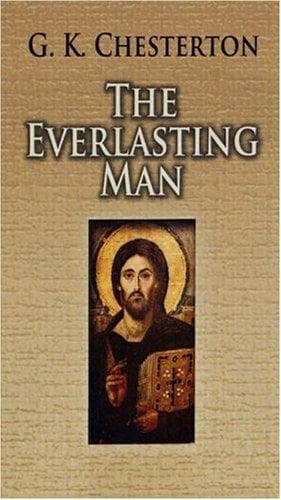
The Everlasting ManChesterton, G. K. (Gilbert Keith)
Religion
The Everlasting Man
Chesterton, G. K. (Gilbert Keith)
Catholic Church -- Apologetic works; Christianity and other religions; Religion
an incessant drive towards democracy; the state and the statesman could
do nothing without a considerable backing of democracy; the sort of
democracy that never has anything to do with diplomacy. It is precisely
because of the presence of Roman democracy that we hear so much about
Roman oligarchy. For instance, recent historians have tried to explain
the valour and victory of Rome in terms of that detestable and detested
usury which was practised by some of the Patricians; as if Curius had
conquered the men of the Macedonian phalanx by lending them money; or
the Consul Nero had negotiated the victory of Metaurus at five per cent.
But we realise the usury of the Patricians because of the perpetual
revolt of the Plebeians. The rule of the Punic merchant princes had the
very soul of usury. But there was never a Punic mob that dared to call
them usurers.
Burdened like all mortal things with all mortal sin and weakness, the
rise of Rome had really been the rise of normal and especially of
popular things; and in nothing more than in the thoroughly normal and
profoundly popular hatred of perversion. Now among the Greeks a
perversion had become a convention. It is true that it had become so
much of a convention, especially a literary convention, that it was
sometimes conventionally copied by Roman literary men. But this is one
of those complications that always arise out of conventions. It must not
obscure our sense of the difference of tone in the two societies as a
whole. It is true that Virgil would once in a way take over a theme of
Theocritus; but nobody can get the impression that Virgil was
particularly fond of that theme. The themes of Virgil were specially and
notably the normal themes, and nowhere more than in morals; piety and
patriotism and the honour of the countryside. And we may well pause upon
the name of the poet as we pass into the autumn of antiquity: upon his
name who was in so supreme a sense the very voice of autumn, of its
maturity and its melancholy; of its fruits of fulfilment and its
prospect of decay. Nobody who reads even a few lines of Virgil can doubt
that he understood what moral sanity means to mankind. Nobody can doubt
his feelings when the demons were driven in flight before the household
gods. But there are two particular points about him and his work which
are particularly important to the main thesis here. The first is that
the whole of his great patriotic epic is in a very peculiar sense
founded upon the fall of Troy; that is, upon an avowed pride in Troy
although she had fallen. In tracing to Trojans the foundation of his
beloved race and republic, he began what may be called the great Trojan
tradition which runs through medieval and modern history. We have
already seen the first hint of it in the pathos of Homer about Hector.
But Virgil turned it not merely into a literature but into a legend. And
it was a legend of the almost divine dignity that belongs to the
defeated.
Public-domain text, read in full here on John Shaqi.
Reviews
Reviews
No reviews yet
Be the first to share your thoughts on this work.
Elsewhere in the archive
Join the Discussion
Join the discussion
Sign in to leave a comment or review.
Sign InorCreate an account