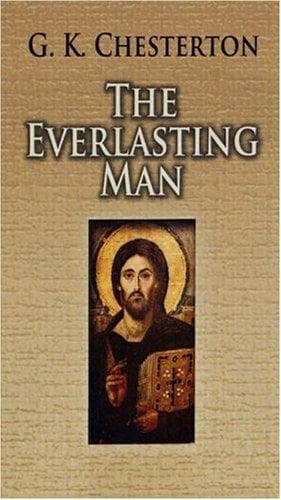
The Everlasting ManChesterton, G. K. (Gilbert Keith)
Religion
The Everlasting Man
Chesterton, G. K. (Gilbert Keith)
Catholic Church -- Apologetic works; Christianity and other religions; Religion
This was one of the traditions that did truly prepare the
world for the coming of Christianity and especially of Christian
chivalry. This is what did help to sustain civilisation through the
incessant defeats of the Dark Ages and the barbarian wars; out of which
what we call chivalry was born. It is the moral attitude of the man with
his back to the wall; and it was the wall of Troy. All through medieval
and modern times this version of the virtues in the Homeric conflict can
be traced in a hundred ways co-operating with all that was akin to it in
Christian sentiment. Our own countrymen, and the men of other countries,
loved to claim like Virgil that their own nation was descended from the
heroic Trojans. All sorts of people thought it the most superb sort of
heraldry to claim to be descended from Hector. Nobody seems to have
wanted to be descended from Achilles. The very fact that the Trojan name
has become a Christian name, and been scattered to the last limits of
Christendom, to Ireland or the Gaelic Highlands, while the Greek name
has remained relatively rare and pedantic, is a tribute to the same
truth. Indeed it involves a curiosity of language almost in the nature
of a joke. The name has been turned into a verb; and the very phrase
about hectoring, in the sense of swaggering, suggests the myriads of
soldiers who have taken the fallen Trojan for a model. As a matter of
fact, nobody in antiquity was less given to hectoring than Hector. But
even the bully pretending to be a conqueror took his title from the
conquered. That is why the popularisation of the Trojan origin by Virgil
has a vital relation to all those elements that have made men say that
Virgil was almost a Christian. It is almost as if two great tools or
toys of the same timber, the divine and the human, had been in the
hands of Providence; and the only thing comparable to the Wooden Cross
of Calvary was the Wooden Horse of Troy. So, in some wild allegory,
pious in purpose if almost profane in form, the Holy Child might have
fought the Dragon with a wooden sword and a wooden horse.
Public-domain text, read in full here on John Shaqi.
Reviews
Reviews
No reviews yet
Be the first to share your thoughts on this work.
Elsewhere in the archive
Join the Discussion
Join the discussion
Sign in to leave a comment or review.
Sign InorCreate an account