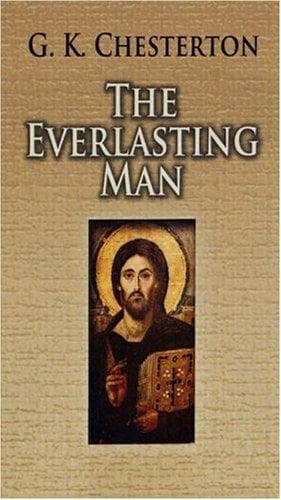
The Everlasting ManChesterton, G. K. (Gilbert Keith)
Religion
The Everlasting Man
Chesterton, G. K. (Gilbert Keith)
Catholic Church -- Apologetic works; Christianity and other religions; Religion
The other element in Virgil which is essential to the argument is the
particular nature of his relation to mythology; or what may here in a
special sense be called folklore, the faiths and fancies of the
populace. Everybody knows that his poetry at its most perfect is less
concerned with the pomposity of Olympus than with the _numina_ of
natural and agricultural life. Every one knows where Virgil looked for
the causes of things. He speaks of finding them not so much in cosmic
allegories of Uranus and Chronos; but rather in Pan and the sisterhood
of the nymphs and the shaggy old man of the forest. He is perhaps most
himself in some passages of the Eclogues, in which he has perpetuated
for ever the great legend of Arcadia and the shepherds. Here again it is
easy enough to miss the point with petty criticism about all the things
that happen to separate his literary convention from ours. There is
nothing more artificial than the cry of artificiality, as directed
against the old pastoral poetry. We have entirely missed all that our
fathers meant by looking at the externals of what they wrote. People
have been so much amused with the mere fact that the china shepherdess
was made of china that they have not even asked why she was made at all.
They have been so content to consider the Merry Peasant as a figure in
an opera that they have not asked even how he came to go to the opera,
or how he strayed on to the stage.
In short, we have only to ask why there is a china shepherdess and not a
china shopkeeper. Why were not mantelpieces adorned with figures of city
merchants in elegant attitudes; of ironmasters wrought in iron, or gold
speculators in gold? Why did the opera exhibit a Merry Peasant and not a
Merry Politician? Why was there not a ballet of bankers, pirouetting
upon pointed toes? Because the ancient instinct and humour of humanity
have always told them, under whatever conventions, that the conventions
of complex cities were less really healthy and happy than the customs of
the countryside. So it is with the eternity of the Eclogues. A modern
poet did indeed write things called Fleet Street Eclogues, in which
poets took the place of the shepherds. But nobody has yet written
anything called Wall Street Eclogues, in which millionaires should take
the place of the poets. And the reason is that there is a real if only a
recurrent yearning for that sort of simplicity; and there is never that
sort of yearning for that sort of complexity. The key to the mystery of
the Merry Peasant is that the peasant often is merry. Those who do not
believe it are simply those who do not know anything about him, and
therefore do not know which are his times for merriment. Those who do
not believe in the shepherd’s feast or song are merely ignorant of the
shepherd’s calendar. The real shepherd is indeed very different from the
ideal shepherd, but that is no reason for forgetting the reality at the
root of the ideal. It needs a truth to make a tradition. It needs a
Public-domain text, read in full here on John Shaqi.
Reviews
Reviews
No reviews yet
Be the first to share your thoughts on this work.
Elsewhere in the archive
Join the Discussion
Join the discussion
Sign in to leave a comment or review.
Sign InorCreate an account