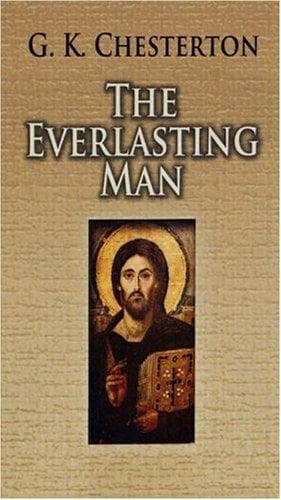
The Everlasting ManChesterton, G. K. (Gilbert Keith)
Religion
The Everlasting Man
Chesterton, G. K. (Gilbert Keith)
Catholic Church -- Apologetic works; Christianity and other religions; Religion
Unless we understand the presence of that Enemy, we shall not only miss
the point of Christianity, but even miss the point of Christmas.
Christmas for us in Christendom has become one thing, and in one sense
even a simple thing. But, like all the truths of that tradition, it is
in another sense a very complex thing. Its unique note is the
simultaneous striking of many notes; of humility, of gaiety, of
gratitude, of mystical fear, but also of vigilance and of drama. It is
not only an occasion for the peacemakers any more than for the
merrymakers; it is not only a Hindu peace conference any more than it is
only a Scandinavian winter feast. There is something defiant in it also;
something that makes the abrupt bells at midnight sound like the great
guns of a battle that has just been won. All this indescribable thing
that we call the Christmas atmosphere only hangs in the air as something
like a lingering fragrance or fading vapour from the exultant explosion
of that one hour in the Judean hills nearly two thousand years ago. But
the savour is still unmistakable, and it is something too subtle or too
solitary to be covered by our use of the word peace. By the very nature
of the story the rejoicings in the cavern were rejoicings in a fortress
or an outlaw’s den; properly understood it is not unduly flippant to say
they were rejoicings in a dug-out. It is not only true that such a
subterranean chamber was a hiding-place from enemies; and that the
enemies were already scouring the stony plain that lay above it like a
sky. It is not only that the very horse-hoofs of Herod might in that
sense have passed like thunder over the sunken head of Christ. It is
also that there is in that image a true idea of an outpost, of a
piercing through the rock and an entrance into an enemy territory. There
is in this buried divinity an idea of _undermining_ the world; of
shaking the towers and palaces from below; even as Herod the great king
felt that earthquake under him and swayed with his swaying palace.
Public-domain text, read in full here on John Shaqi.
Reviews
Reviews
No reviews yet
Be the first to share your thoughts on this work.
Elsewhere in the archive
Join the Discussion
Join the discussion
Sign in to leave a comment or review.
Sign InorCreate an account