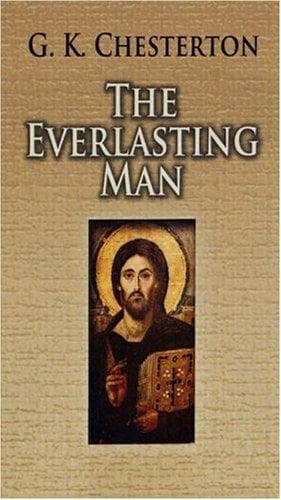
The Everlasting ManChesterton, G. K. (Gilbert Keith)
Religion
The Everlasting Man
Chesterton, G. K. (Gilbert Keith)
Catholic Church -- Apologetic works; Christianity and other religions; Religion
That is perhaps the mightiest of the mysteries of the cave. It is
already apparent that though men are said to have looked for hell under
the earth, in this case it is rather heaven that is under the earth. And
there follows in this strange story the idea of an upheaval of heaven.
That is the paradox of the whole position; that henceforth the highest
thing can only work from below. Royalty can only return to its own by a
sort of rebellion. Indeed the Church from its beginnings, and perhaps
especially in its beginnings, was not so much a principality as a
revolution against the prince of the world. This sense that the world
had been conquered by the great usurper, and was in his possession, has
been much deplored or derided by those optimists who identify
enlightenment with ease. But it was responsible for all that thrill of
defiance and a beautiful danger that made the good news seem to be
really both good and new. It was in truth against a huge unconscious
usurpation that it raised a revolt, and originally so obscure a revolt.
Olympus still occupied the sky like a motionless cloud moulded into many
mighty forms; philosophy still sat in the high places and even on the
thrones of the kings, when Christ was born in the cave and Christianity
in the catacombs.
In both cases we may remark the same paradox of revolution; the sense of
something despised and of something feared. The cave in one aspect is
only a hole or corner into which the outcasts are swept like rubbish;
yet in the other aspect it is a hiding-place of something valuable which
the tyrants are seeking like treasure. In one sense they are there
because the innkeeper would not even remember them, and in another
because the king can never forget them. We have already noted that this
paradox appeared also in the treatment of the early Church. It was
important while it was still insignificant, and certainly while it was
still impotent. It was important solely because it was intolerable; and
in that sense it is true to say that it was intolerable because it was
intolerant. It was resented, because, in its own still and almost secret
way, it had declared war. It had risen out of the ground to wreck the
heaven and earth of heathenism. It did not try to destroy all that
creation of gold and marble; but it contemplated a world without it. It
dared to look right through it as though the gold and marble had been
glass. Those who charged the Christians with burning down Rome with
firebrands were slanderers; but they were at least far nearer to the
nature of Christianity than those among the moderns who tell us that the
Christians were a sort of ethical society, being martyred in a languid
fashion for telling men they had a duty to their neighbours, and only
mildly disliked because they were meek and mild.
Public-domain text, read in full here on John Shaqi.
Reviews
Reviews
No reviews yet
Be the first to share your thoughts on this work.
Elsewhere in the archive
Join the Discussion
Join the discussion
Sign in to leave a comment or review.
Sign InorCreate an account