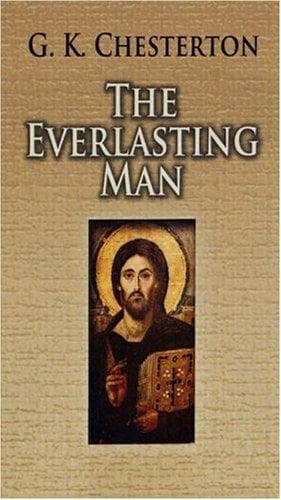
The Everlasting ManChesterton, G. K. (Gilbert Keith)
Religion
The Everlasting Man
Chesterton, G. K. (Gilbert Keith)
Catholic Church -- Apologetic works; Christianity and other religions; Religion
Herod had his place, therefore, in the miracle play of Bethlehem because
he is the menace to the Church Militant and shows it from the first as
under persecution and fighting for its life. For those who think this a
discord, it is a discord that sounds simultaneously with the Christmas
bells. For those who think the idea of the Crusade is one that spoils
the idea of the Cross, we can only say that for them the idea of the
Cross is spoiled; the idea of the Cross is spoiled quite literally in
the Cradle. It is not here to the purpose to argue with them on the
abstract ethics of fighting; the purpose in this place is merely to sum
up the combination of ideas that make up the Christian and Catholic
idea, and to note that all of them are already crystallised in the first
Christmas story. They are three distinct and commonly contrasted things
which are nevertheless one thing; but this is the only thing which can
make them one. The first is the human instinct for a heaven that shall
be as literal and almost as local as a home. It is the idea pursued by
all poets and pagans making myths; that a particular place must be the
shrine of the god or the abode of the blest; that fairyland is a land;
or that the return of the ghost must be the resurrection of the body. I
do not here reason about the refusal of rationalism to satisfy this
need. I only say that if the rationalists refuse to satisfy it, the
pagans will not be satisfied. This is present in the story of Bethlehem
and Jerusalem as it is present in the story of Delos and Delphi; and as
it is _not_ present in the whole universe of Lucretius or the whole
universe of Herbert Spencer. The second element is a philosophy _larger_
than other philosophies; larger than that of Lucretius and infinitely
larger than that of Herbert Spencer. It looks at the world through a
hundred windows where the ancient stoic or the modern agnostic only
looks through one. It sees life with thousands of eyes belonging to
thousands of different sorts of people, where the other is only the
individual standpoint of a stoic or an agnostic. It has something for
all moods of man, it finds work for all kinds of men, it understands
secrets of psychology, it is aware of depths of evil, it is able to
distinguish between real and unreal marvels and miraculous exceptions,
it trains itself in tact about hard cases, all with a multiplicity and
subtlety and imagination about the varieties of life which is far beyond
the bald or breezy platitudes of most ancient or modern moral
philosophy. In a word, there is more in it; it finds more in existence
to think about; it gets more out of life. Masses of this material about
our many-sided life have been added since the time of St. Thomas
Aquinas. But St. Thomas Aquinas alone would have found himself limited
in the world of Confucius or of Comte. And the third point is this: that
while it is local enough for poetry and larger than any other
philosophy, it is also a challenge and a fight.
Public-domain text, read in full here on John Shaqi.
Reviews
Reviews
No reviews yet
Be the first to share your thoughts on this work.
Elsewhere in the archive
Join the Discussion
Join the discussion
Sign in to leave a comment or review.
Sign InorCreate an account