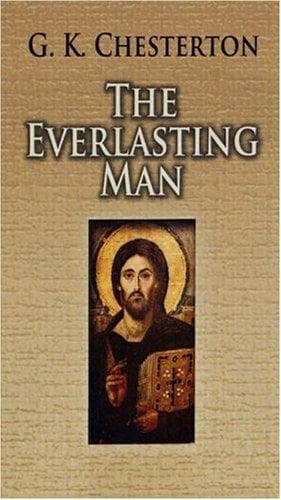
The Everlasting ManChesterton, G. K. (Gilbert Keith)
Religion
The Everlasting Man
Chesterton, G. K. (Gilbert Keith)
Catholic Church -- Apologetic works; Christianity and other religions; Religion
While it is deliberately
broadened to embrace every aspect of truth, it is still stiffly
embattled against every mode of error. It gets every kind of man to
fight for it, it gets every kind of weapon to fight with, it widens its
knowledge of the things that are fought for and against with every art
of curiosity or sympathy; but it never forgets that it is fighting. It
proclaims peace on earth and never forgets why there was war in heaven.
This is the trinity of truths symbolised here by the three types in the
old Christmas story: the shepherds and the kings and that other king who
warred upon the children. It is simply not true to say that other
religions and philosophies are in this respect its rivals. It is not
true to say that any one of them combines these characters; it is not
true to say that any one of them pretends to combine them. Buddhism may
profess to be equally mystical; it does not even profess to be equally
military. Islam may profess to be equally military; it does not even
profess to be equally metaphysical and subtle. Confucianism may profess
to satisfy the need of the philosophers for order and reason; it does
not even profess to satisfy the need of the mystics for miracle and
sacrament and the consecration of concrete things. There are many
evidences of this presence of a spirit at once universal and unique. One
will serve here which is the symbol of the subject of this chapter; that
no other story, no pagan legend or philosophical anecdote or historical
event, does in fact affect any of us with that peculiar and even
poignant impression produced on us by the word Bethlehem. No other birth
of a god or childhood of a sage seems to us to be Christmas or anything
like Christmas. It is either too cold or too frivolous, or too formal
and classical, or too simple and savage, or too occult and complicated.
Not one of us, whatever his opinions, would ever go to such a scene with
the sense that he was going home. He might admire it because it was
poetical, or because it was philosophical, or any number of other things
in separation; but not because it was itself. The truth is that there is
a quite peculiar and individual character about the hold of this story
on human nature; it is not in its psychological substance at all like a
mere legend or the life of a great man. It does not exactly in the
ordinary sense turn our minds to greatness; to those extensions and
exaggerations of humanity which are turned into gods and heroes, even by
the healthiest sort of hero-worship. It does not exactly work outwards,
adventurously, to the wonders to be found at the ends of the earth. It
is rather something that surprises us from behind, from the hidden and
personal part of our being; like that which can sometimes take us off
our guard in the pathos of small objects or the blind pieties of the
poor. It is rather as if a man had found an inner room in the very heart
of his own house which he had never suspected; and seen a light from
within.
Public-domain text, read in full here on John Shaqi.
Reviews
Reviews
No reviews yet
Be the first to share your thoughts on this work.
Elsewhere in the archive
Join the Discussion
Join the discussion
Sign in to leave a comment or review.
Sign InorCreate an account