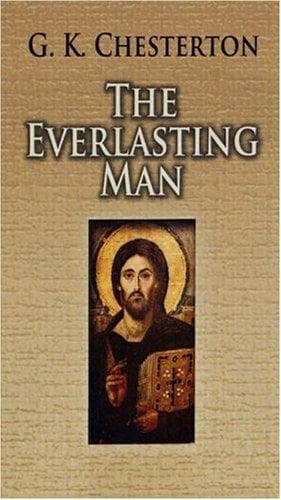
The Everlasting ManChesterton, G. K. (Gilbert Keith)
Religion
The Everlasting Man
Chesterton, G. K. (Gilbert Keith)
Catholic Church -- Apologetic works; Christianity and other religions; Religion
It is as if he found something at the back of his own heart that
betrayed him into good. It is not made of what the world would call
strong materials; or rather it is made of materials whose strength is in
that winged levity with which they brush us and pass. It is all that is
in us but a brief tenderness that is there made eternal; all that means
no more than a momentary softening that is in some strange fashion
become a strengthening and a repose; it is the broken speech and the
lost word that are made positive and suspended unbroken; as the strange
kings fade into a far country and the mountains resound no more with the
feet of the shepherds; and only the night and the cavern lie in fold
upon fold over something more human than humanity.
CHAPTER II
THE RIDDLES OF THE GOSPEL
To understand the nature of this chapter, it is necessary to recur to
the nature of this book. The argument which is meant to be the backbone
of the book is of the kind called the _reductio ad absurdum_. It
suggests that the results of assuming the rationalist thesis are more
irrational than ours; but to prove it we must assume that thesis. Thus
in the first section I often treated man as merely an animal, to show
that the effect was more impossible than if he were treated as an angel.
In the sense in which it was necessary to treat man merely as an animal,
it is necessary to treat Christ merely as a man. I have to suspend my
own beliefs, which are much more positive; and assume this limitation
even in order to remove it. I must try to imagine what would happen to a
man who did really read the story of Christ as the story of a man; and
even of a man of whom he had never heard before. And I wish to point out
that a really impartial reading of that kind would lead, if not
immediately to belief, at least to a bewilderment of which there is
really no solution except in belief. In this chapter, for this reason, I
shall bring in nothing of the spirit of my own creed; I shall exclude
the very style of diction, and even of lettering, which I should think
fitting in speaking in my own person. I am speaking as an imaginary
heathen human being, honestly staring at the Gospel story for the first
time.
Public-domain text, read in full here on John Shaqi.
Reviews
Reviews
No reviews yet
Be the first to share your thoughts on this work.
Elsewhere in the archive
Join the Discussion
Join the discussion
Sign in to leave a comment or review.
Sign InorCreate an account