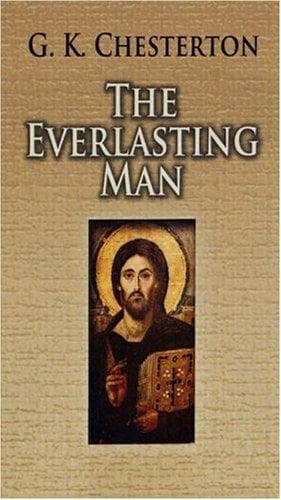
The Everlasting ManChesterton, G. K. (Gilbert Keith)
Religion
The Everlasting Man
Chesterton, G. K. (Gilbert Keith)
Catholic Church -- Apologetic works; Christianity and other religions; Religion
Now it is not at all easy to regard the New Testament as a New
Testament. It is not at all easy to realise the good news as new. Both
for good and evil familiarity fills us with assumptions and
associations; and no man of our civilisation, whatever he thinks of our
religion, can really read the thing as if he had never heard of it
before. Of course it is in any case utterly unhistorical to talk as if
the New Testament were a neatly bound book that had fallen from heaven.
It is simply the selection made by the authority of the Church from a
mass of early Christian literature. But apart from any such question,
there is a psychological difficulty in feeling the New Testament as new.
There is a psychological difficulty in seeing those well-known words
simply as they stand and without going beyond what they intrinsically
stand for. And this difficulty must indeed be very great; for the result
of it is very curious. The result of it is that most modern critics and
most current criticism, even popular criticism, makes a comment that is
the exact reverse of the truth. It is so completely the reverse of the
truth that one could almost suspect that they had never read the New
Testament at all.
We have all heard people say a hundred times over, for they seem never
to tire of saying it, that the Jesus of the New Testament is indeed a
most merciful and humane lover of humanity, but that the Church has
hidden this human character in repellent dogmas and stiffened it with
ecclesiastical terrors till it has taken on an inhuman character. This
is, I venture to repeat, very nearly the reverse of the truth. The truth
is that it is the image of Christ in the churches that is almost
entirely mild and merciful. It is the image of Christ in the Gospels
that is a good many other things as well. The figure in the Gospels does
indeed utter in words of almost heart-breaking beauty his pity for our
broken hearts. But they are very far from being the only sort of words
that he utters. Nevertheless they are almost the only kind of words that
the Church in its popular imagery ever represents him as uttering. That
popular imagery is inspired by a perfectly sound popular instinct. The
mass of the poor are broken, and the mass of the people are poor, and
for the mass of mankind the main thing is to carry the conviction of the
incredible compassion of God. But nobody with his eyes open can doubt
that it is chiefly this idea of compassion that the popular machinery of
the Church does seek to carry. The popular imagery carries a great deal
to excess the sentiment of ‘Gentle Jesus, meek and mild.’ It is the
first thing that the outsider feels and criticises in a Pietà or a
shrine of the Sacred Heart. As I say, while the art may be insufficient,
I am not sure that the instinct is unsound. In any case there is
something appalling, something that makes the blood run cold, in the
idea of having a statue of Christ in wrath. There is something
Public-domain text, read in full here on John Shaqi.
Reviews
Reviews
No reviews yet
Be the first to share your thoughts on this work.
Elsewhere in the archive
Join the Discussion
Join the discussion
Sign in to leave a comment or review.
Sign InorCreate an account