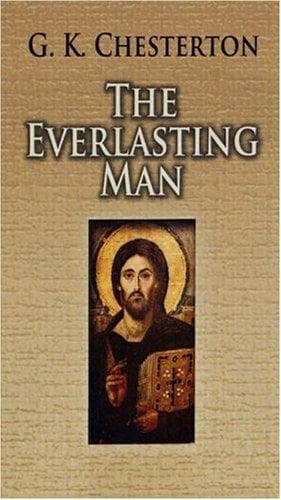
The Everlasting ManChesterton, G. K. (Gilbert Keith)
Religion
The Everlasting Man
Chesterton, G. K. (Gilbert Keith)
Catholic Church -- Apologetic works; Christianity and other religions; Religion
insupportable even to the imagination in the idea of turning the corner
of a street or coming out into the spaces of a market-place to meet the
petrifying petrifaction of _that_ figure as it turned upon a generation
of vipers, or that face as it looked at the face of a hypocrite. The
Church can reasonably be justified therefore if she turns the most
merciful face or aspect towards men; but it is certainly the most
merciful aspect that she does turn. And the point is here that it is
very much more specially and exclusively merciful than any impression
that could be formed by a man merely reading the New Testament for the
first time. A man simply taking the words of the story as they stand
would form quite another impression; an impression full of mystery and
possibly of inconsistency; but certainly not merely an impression of
mildness. It would be intensely interesting; but part of the interest
would consist in its leaving a good deal to be guessed at or explained.
It is full of sudden gestures evidently significant except that we
hardly know what they signify; of enigmatic silences; of ironical
replies. The outbreaks of wrath, like storms above our atmosphere, do
not seem to break out exactly where we should expect them, but to follow
some higher weather-chart of their own. The Peter whom popular Church
teaching presents is very rightly the Peter to whom Christ said in
forgiveness, ‘Feed my lambs.’ He is not the Peter upon whom Christ
turned as if he were the devil, crying in that obscure wrath, ‘Get thee
behind me, Satan.’ Christ lamented with nothing but love and pity over
Jerusalem which was to murder him. We do not know what strange spiritual
atmosphere or spiritual insight led him to sink Bethsaida lower in the
pit than Sodom. I am putting aside for the moment all questions of
doctrinal inferences or expositions, orthodox or otherwise; I am simply
imagining the effect on a man’s mind if he did really do what these
critics are always talking about doing; if he did really read the New
Testament without reference to orthodoxy and even without reference to
doctrine. He would find a number of things which fit in far less with
the current unorthodoxy than they do with the current orthodoxy. He
would find, for instance, that if there are any descriptions that
deserved to be called realistic, they are precisely the descriptions of
the supernatural. If there is one aspect of the New Testament Jesus in
which he may be said to present himself eminently as a practical person,
it is in the aspect of an exorcist. There is nothing meek and mild,
there is nothing even in the ordinary sense mystical, about the tone of
the voice that says ‘Hold thy peace and come out of him.’ It is much
more like the tone of a very business-like lion-tamer or a strong-minded
doctor dealing with a homicidal maniac. But this is only a side issue
for the sake of illustration; I am not now raising these controversies;
Public-domain text, read in full here on John Shaqi.
Reviews
Reviews
No reviews yet
Be the first to share your thoughts on this work.
Elsewhere in the archive
Join the Discussion
Join the discussion
Sign in to leave a comment or review.
Sign InorCreate an account