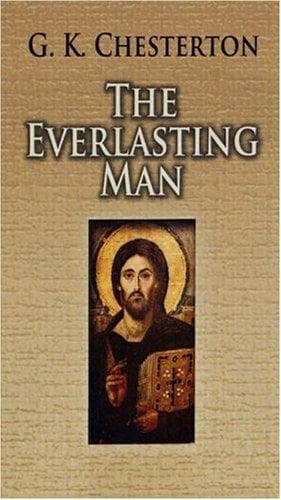
The Everlasting ManChesterton, G. K. (Gilbert Keith)
Religion
The Everlasting Man
Chesterton, G. K. (Gilbert Keith)
Catholic Church -- Apologetic works; Christianity and other religions; Religion
but considering the case of the imaginary man from the moon to whom the
New Testament is new.
Now the first thing to note is that if we take it merely as a human
story, it is in some ways a very strange story. I do not refer here to
its tremendous and tragic culmination or to any implications involving
triumph in that tragedy. I do not refer to what is commonly called the
miraculous element; for on that point philosophies vary and modern
philosophies very decidedly waver. Indeed the educated Englishman of
to-day may be said to have passed from an old fashion, in which he would
not believe in any miracles unless they were ancient, and adopted a new
fashion in which he will not believe in any miracles unless they are
modern. He used to hold that miraculous cures stopped with the first
Christians and is now inclined to suspect that they began with the first
Christian Scientists. But I refer here rather specially to unmiraculous
and even to unnoticed and inconspicuous parts of the story. There are a
great many things about it which nobody would have invented, for they
are things that nobody has ever made any particular use of; things which
if they were remarked at all have remained rather as puzzles. For
instance, there is that long stretch of silence in the life of Christ up
to the age of thirty. It is of all silences the most immense and
imaginatively impressive. But it is not the sort of thing that anybody
is particularly likely to invent in order to prove something; and nobody
so far as I know has ever tried to prove anything in particular from it.
It is impressive, but it is only impressive as a fact; there is nothing
particularly popular or obvious about it as a fable. The ordinary trend
of hero-worship and myth-making is much more likely to say the precise
opposite. It is much more likely to say (as I believe some of the
gospels rejected by the Church do say) that Jesus displayed a divine
precocity and began his mission at a miraculously early age. And there
is indeed something strange in the thought that he who of all humanity
needed least preparation seems to have had most. Whether it was some
mode of the divine humility, or some truth of which we see the shadow
in the longer domestic tutelage of the higher creatures of the earth, I
do not propose to speculate; I mention it simply as an example of the
sort of thing that does in any case give rise to speculations, quite
apart from recognised religious speculations. Now the whole story is
full of these things. It is not by any means, as baldly presented in
print, a story that it is easy to get to the bottom of. It is anything
but what these people talk of as a simple Gospel. Relatively speaking,
it is the Gospel that has the mysticism and the Church that has the
rationalism. As I should put it, of course, it is the Gospel that is the
riddle and the Church that is the answer. But whatever be the answer,
the Gospel as it stands is almost a book of riddles.
Public-domain text, read in full here on John Shaqi.
Reviews
Reviews
No reviews yet
Be the first to share your thoughts on this work.
Elsewhere in the archive
Join the Discussion
Join the discussion
Sign in to leave a comment or review.
Sign InorCreate an account