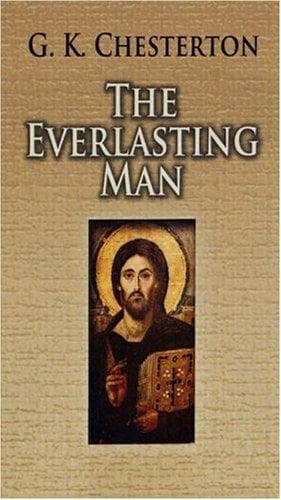
The Everlasting ManChesterton, G. K. (Gilbert Keith)
Religion
The Everlasting Man
Chesterton, G. K. (Gilbert Keith)
Catholic Church -- Apologetic works; Christianity and other religions; Religion
First, a man reading the Gospel sayings would not find platitudes. If he
had read even in the most respectful spirit the majority of ancient
philosophers and of modern moralists, he would appreciate the unique
importance of saying that he did not find platitudes. It is more than
can be said even of Plato. It is much more than can be said of Epictetus
or Seneca or Marcus Aurelius or Apollonius of Tyana. And it is
immeasurably more than can be said of most of the agnostic moralists and
the preachers of the ethical societies; with their songs of service and
their religion of brotherhood. The morality of most moralists, ancient
and modern, has been one solid and polished cataract of platitudes
flowing for ever and ever. That would certainly not be the impression of
the imaginary independent outsider studying the New Testament. He would
be conscious of nothing so commonplace and in a sense of nothing so
continuous as that stream. He would find a number of strange claims that
might sound like the claim to be the brother of the sun and moon; a
number of very startling pieces of advice; a number of stunning rebukes;
a number of strangely beautiful stories. He would see some very
gigantesque figures of speech about the impossibility of threading a
needle with a camel or the possibility of throwing a mountain into the
sea. He would see a number of very daring simplifications of the
difficulties of life; like the advice to shine upon everybody
indifferently as does the sunshine or not to worry about the future any
more than the birds. He would find on the other hand some passages of
almost impenetrable darkness, so far as he is concerned, such as the
moral of the parable of the Unjust Steward. Some of these things might
strike him as fables and some as truths; but none as truisms. For
instance, he would not find the ordinary platitudes in favour of peace.
He would find several paradoxes in favour of peace. He would find
several ideals of non-resistance, which taken as they stand would be
rather too pacific for any pacifist. He would be told in one passage to
treat a robber _not_ with passive resistance, but rather with positive
and enthusiastic encouragement, if the terms be taken literally; heaping
up gifts upon the man who had stolen goods. But he would not find a word
of all that obvious rhetoric against war which has filled countless
books and odes and orations; not a word about the wickedness of war, the
wastefulness of war, the appalling scale of the slaughter in war and all
the rest of the familiar frenzy; indeed not a word about war at all.
There is nothing that throws any particular light on Christ’s attitude
towards organised warfare, except that he seems to have been rather fond
of Roman soldiers. Indeed it is another perplexity, speaking from the
same external and human standpoint, that he seems to have got on much
better with Romans than he did with Jews. But the question here is a
Public-domain text, read in full here on John Shaqi.
Reviews
Reviews
No reviews yet
Be the first to share your thoughts on this work.
Elsewhere in the archive
Join the Discussion
Join the discussion
Sign in to leave a comment or review.
Sign InorCreate an account