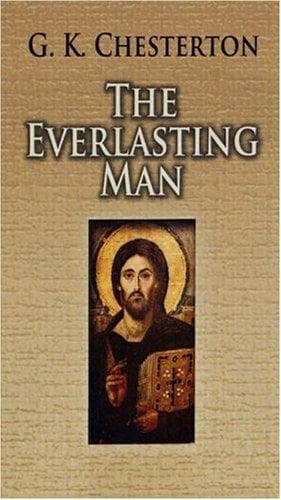
The Everlasting ManChesterton, G. K. (Gilbert Keith)
Religion
The Everlasting Man
Chesterton, G. K. (Gilbert Keith)
Catholic Church -- Apologetic works; Christianity and other religions; Religion
certain tone to be appreciated by merely reading a certain text; and we
might give any number of instances of it.
The statement that the meek shall inherit the earth is very far from
being a meek statement. I mean it is not meek in the ordinary sense of
mild and moderate and inoffensive. To justify it, it would be necessary
to go very deep into history and anticipate things undreamed of then and
by many unrealised even now; such as the way in which the mystical monks
reclaimed the lands which the practical kings had lost. If it was a
truth at all, it was because it was a prophecy. But certainly it was not
a truth in the sense of a truism. The blessing upon the meek would seem
to be a very violent statement; in the sense of doing violence to reason
and probability. And with this we come to another important stage in the
speculation. As a prophecy it really was fulfilled; but it was only
fulfilled long afterwards. The monasteries were the most practical and
prosperous estates and experiments in reconstruction after the barbaric
deluge; the meek did really inherit the earth. But nobody could have
known anything of the sort at the time--unless indeed there was one who
knew. Something of the same thing may be said about the incident of
Martha and Mary; which has been interpreted in retrospect and from the
inside by the mystics of the Christian contemplative life. But it was
not at all an obvious view of it; and most moralists, ancient and
modern, could be trusted to make a rush for the obvious. What torrents
of effortless eloquence would have flowed from them to swell any slight
superiority on the part of Martha; what splendid sermons about the Joy
of Service and the Gospel of Work and the World Left Better Than We
Found It, and generally all the ten thousand platitudes that can be
uttered in favour of taking trouble--by people who need take no trouble
to utter them. If in Mary the mystic and child of love Christ was
guarding the seed of something more subtle, who was likely to understand
it at the time? Nobody else could have seen Clare and Catherine and
Teresa shining above the little roof at Bethany. It is so in another way
with that magnificent menace about bringing into the world a sword to
sunder and divide. Nobody could have guessed then either how it could
be fulfilled or how it could be justified. Indeed some freethinkers are
still so simple as to fall into the trap and be shocked at a phrase so
deliberately defiant. They actually complain of the paradox for not
being a platitude.
Public-domain text, read in full here on John Shaqi.
Reviews
Reviews
No reviews yet
Be the first to share your thoughts on this work.
Elsewhere in the archive
Join the Discussion
Join the discussion
Sign in to leave a comment or review.
Sign InorCreate an account