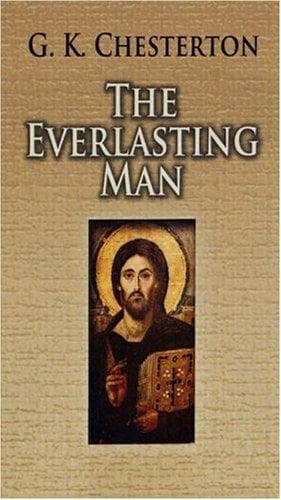
The Everlasting ManChesterton, G. K. (Gilbert Keith)
Religion
The Everlasting Man
Chesterton, G. K. (Gilbert Keith)
Catholic Church -- Apologetic works; Christianity and other religions; Religion
The truth is that in one sense a man might very well have predicted that
the imperial decadence would produce something like Christianity. That
is, something a little like and gigantically different. A man might very
well have said, for instance, ‘Pleasure has been pursued so
extravagantly that there will be a reaction into pessimism. Perhaps it
will take the form of asceticism; men will mutilate themselves instead
of merely hanging themselves.’ Or a man might very reasonably have said,
‘If we weary of our Greek and Latin gods we shall be hankering after
some eastern mystery or other; there will be a fashion in Persians or
Hindoos.’ Or a man of the world might well have been shrewd enough to
say, ‘Powerful people are picking up these fads; some day the court will
adopt one of them and it may become official.’ Or yet another and
gloomier prophet might be pardoned for saying, ‘The world is going
down-hill; dark and barbarous superstitions will return, it does not
matter much which. They will all be formless and fugitive like dreams of
the night.’
Now it is the intense interest of the case that all these prophecies
were really fulfilled; but it was not the Church that fulfilled them. It
was the Church that escaped from them, confounded them, and rose above
them in triumph. In so far as it was probable that the mere nature of
hedonism would produce a mere reaction of asceticism, it did produce a
mere reaction of asceticism. It was the movement called Manichean, and
the Church was its mortal enemy. In so far as it would have naturally
appeared at that point of history, it did appear; it did also disappear,
which was equally natural. The mere pessimist reaction did come with the
Manichees and did go with the Manichees. But the Church did not come
with them or go with them; and she had much more to do with their going
than with their coming. Or again, in so far as it was probable that even
the growth of scepticism would bring in a fashion of eastern religion,
it did bring it in; Mithras came from far beyond Palestine out of the
heart of Persia, bringing strange mysteries of the blood of bulls.
Certainly there was everything to show that some such fashion would have
come in any case. But certainly there is nothing in the world to show
that it would not have passed away in any case. Certainly an Oriental
fad was something eminently fitted to the fourth or fifth century; but
that hardly explains it having remained to the twentieth century, and
still going strong. In short, in so far as things of the kind might have
been expected then, things like Mithraism were experienced then; but it
scarcely explains our more recent experiences. And if we were still
Mithraists merely because Mithraic head-dresses and other Persian
apparatuses might be expected to be all the rage in the days of
Domitian, it would almost seem by this time that we must be a little
dowdy.
Public-domain text, read in full here on John Shaqi.
Reviews
Reviews
No reviews yet
Be the first to share your thoughts on this work.
Elsewhere in the archive
Join the Discussion
Join the discussion
Sign in to leave a comment or review.
Sign InorCreate an account