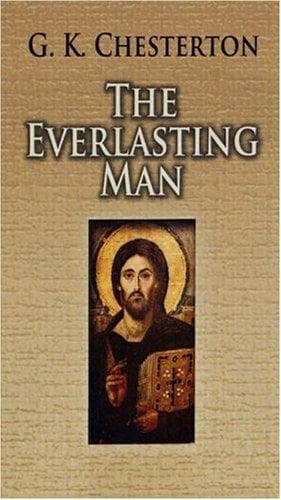
The Everlasting ManChesterton, G. K. (Gilbert Keith)
Religion
The Everlasting Man
Chesterton, G. K. (Gilbert Keith)
Catholic Church -- Apologetic works; Christianity and other religions; Religion
It is the same, as will be suggested in a moment, with the idea of
official favouritism. In so far as such favouritism shown towards a fad
was something that might have been looked for during the decline and
fall of the Roman Empire, it was something that did exist in that Empire
and did decline and fall with it. It throws no sort of light on the
thing that resolutely refused to decline and fall; that grew steadily
while the other was declining and falling; and which even at this moment
is going forward with fearless energy, when another aeon has completed
its cycle and another civilisation seems almost ready to fall or to
decline.
Now the curious fact is this; that the very heresies which the Early
Church is blamed for crushing testify to the unfairness for which she is
blamed. In so far as something deserved the blame, it was precisely the
things that she is blamed for blaming. In so far as something was merely
a superstition, she herself condemned that superstition. In so far as
something was a mere reaction into barbarism, she herself resisted it
because it was a reaction into barbarism. In so far as something was a
fad of the fading empire, that died and deserved to die, it was the
Church alone that killed it. The Church is reproached for being exactly
what the heresy was repressed for being. The explanations of the
evolutionary historians and higher critics do really explain why
Arianism and Gnosticism and Nestorianism were born--and also why they
died. They do not explain why the Church was born or why she has refused
to die. Above all, they do not explain why she should have made war on
the very evils she is supposed to share.
Let us take a few practical examples of the principle; the principle
that if there was anything that was really a superstition of the dying
empire, it did really die with the dying empire; and certainly was not
the same as the very thing that destroyed it. For this purpose we will
take in order two or three of the most ordinary explanations of
Christian origins among the modern critics of Christianity. Nothing is
more common, for instance, than to find such a modern critic writing
something like this: ‘Christianity was above all a movement of ascetics,
a rush into the desert, a refuge in the cloister, a renunciation of all
life and happiness; and this was a part of a gloomy and inhuman reaction
against nature itself, a hatred of the body, a horror of the material
universe, a sort of universal suicide of the senses and even of the
self. It came from an eastern fanaticism like that of the fakirs and was
ultimately founded on an eastern pessimism, which seems to feel
existence itself as an evil.’
Public-domain text, read in full here on John Shaqi.
Reviews
Reviews
No reviews yet
Be the first to share your thoughts on this work.
Elsewhere in the archive
Join the Discussion
Join the discussion
Sign in to leave a comment or review.
Sign InorCreate an account