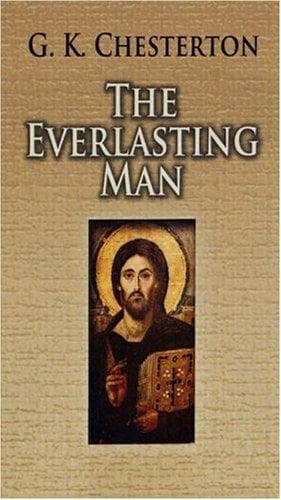
The Everlasting ManChesterton, G. K. (Gilbert Keith)
Religion
The Everlasting Man
Chesterton, G. K. (Gilbert Keith)
Catholic Church -- Apologetic works; Christianity and other religions; Religion
purely spiritual order which had been betrayed by the coarse and clumsy
trick of making such toys as the sun and moon and stars. Anyhow all this
dark tide out of the metaphysical sea in the midst of Asia poured
through the dykes simultaneously with the creed of Christ; but it is the
whole point of the story that the two were not the same; that they
flowed like oil and water. That creed remained in the shape of a
miracle; a river still flowing through the sea. And the proof of the
miracle was practical once more; it was merely that while all that sea
was salt and bitter with the savour of death, of this one stream in the
midst of it a man could drink.
Now that purity was preserved by dogmatic definitions and exclusions. It
could not possibly have been preserved by anything else. If the Church
had not renounced the Manicheans it might have become merely Manichean.
If it had not renounced the Gnostics it might have become Gnostic. But
by the very fact that it did renounce them it proved that it was not
either Gnostic or Manichean. At any rate it proved that something was
not either Gnostic or Manichean; and what could it be that condemned
them, if it was not the original good news of the runners from Bethlehem
and the trumpet of the Resurrection? The early Church was ascetic, but
she proved that she was not pessimistic, simply by condemning the
pessimists. The creed declared that man was sinful, but it did not
declare that life was evil, and it proved it by damning those who did.
The condemnation of the early heretics is itself condemned as something
crabbed and narrow; but it was in truth the very proof that the Church
meant to be brotherly and broad. It proved that the primitive Catholics
were specially eager to explain that they did _not_ think man utterly
vile; that they did _not_ think life incurably miserable; that they did
_not_ think marriage a sin or procreation a tragedy. They were ascetic
because asceticism was the only possible purge of the sins of the world;
but in the very thunder of their anathemas they affirmed for ever that
their asceticism was not to be anti-human or anti-natural; that they did
wish to purge the world and not destroy it. And nothing else except
those anathemas could possibly have made it clear, amid a confusion
which still confuses them with their mortal enemies. Nothing else but
dogma could have resisted the riot of imaginative invention with which
the pessimists were waging their war against nature; with their Aeons
and their Demiurge, their strange Logos and their sinister Sophia. If
the Church had not insisted on theology, it would have melted into a mad
mythology of the mystics, yet further removed from reason or even from
rationalism; and, above all, yet further removed from life and from the
love of life. Remember that it would have been an inverted mythology,
one contradicting everything natural in paganism; a mythology in which
Pluto would be above Jupiter and Hades hang higher than Olympus; in
Public-domain text, read in full here on John Shaqi.
Reviews
Reviews
No reviews yet
Be the first to share your thoughts on this work.
Elsewhere in the archive
Join the Discussion
Join the discussion
Sign in to leave a comment or review.
Sign InorCreate an account